

Emergency room visits related to tick bites are increasing nationwide this year, according to new data from the Centers for Disease Control and Prevention. In response, experts in Champaign-Urbana are recommending residents take steps to protect themselves and their pets from tick exposure.
Dawn Carson, the communications disease investigator at the Champaign-Urbana Public Health District, said the most common tick-borne illnesses in Illinois are Lyme disease, ehrlichiosis and Rocky Mountain spotted fever. While all are treatable, she emphasized the importance of early detection.
“Treatment needs to be prompt. You need to quickly identify that you have a tick-borne disease,” Carson said. “And that’s where it gets tricky, because when people are diagnosed with a tick-borne disease, about 50% of them don’t ever remember being bitten by a tick.”
It is crucial to remember that ticks can thrive in many green spaces, not just parks or wooded areas, she added.
“You don’t have to be hiking or camping to get exposed to ticks, you know,” Carson said. “Tall grass in your yard can carry ticks, tall vegetation around the edges of your yard can carry ticks, and so you want to mow your yard frequently.”
She recommends taking a shower within two hours of being outdoors to remove any ticks that might be crawling on your skin. Washing your clothes or putting them in the dryer on high heat can also kill ticks.
If spending a lot of time in areas where ticks might be present, Carson said people should consider treating their clothes with tick repellents, like permethrin. She said it is also important that pets have tick prevention all year round.
Urbana resident Greg Jahiel is now taking some of those precautions when he goes on walks in Meadowbrook Park with his dog, Dino, after encountering some ticks at the beginning of the summer.

“We were running in one of the trails, and I looked down and there were, like, three ticks crawling up my shoes. Then I looked over, I stopped to brush them off, and there were four crawling up Dino’s leg,” he said. “It totally felt like a horror movie.”
Jahiel said one of the ticks was attached to his skin, but he was able to remove it quickly and did not get a rash or experience any symptoms.
Dino takes a monthly tick and flea preventative for pets, and now, Jahiel uses insect repellents on his clothing.
“I have my running shoes, my running shorts and my running socks treated with permethrin,” he said. “Then I typically will spray myself with just a little bit of DEET, or something with DEET in it, before I go running.”
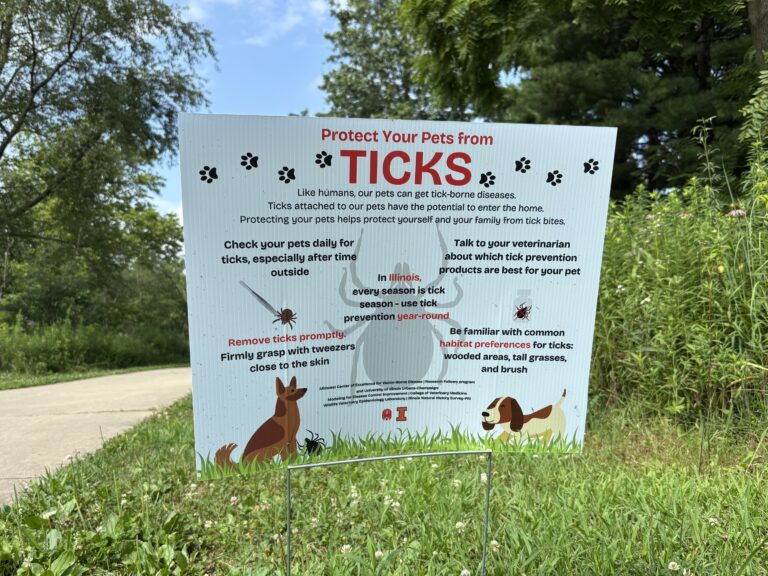
Around Meadowbrook Park, various signs inform people on how to protect their pets from ticks, too. Jahiel said it seems like there are more ticks in the area this season compared to previous years.

Entomologist Chris Stone, who leads the Medical Entomology Lab at the Illinois Natural History Survey, said there are several possible reasons for the increase in tick encounters this year.
He said one likely cause is that certain species are going to areas where the deer population has increased.
“The increase in deer population has been suggested to be a really important factor for the spread of Lone Star ticks further north because they really rely on deer,” Stone explained. “Also, for the black legged ticks that, as adults, feed on deer.”
Stone said tick expansion could also be linked to climate change because milder winters and wetter springs help ticks survive longer. But, he said the topic is still debated and there is not enough evidence to prove that in the area.
As part of his role in the lab, Stone also runs a passive surveillance program where residents can submit ticks they’ve found on themselves or their pets. The ticks are identified by the researchers and added to a database available online called the Bite Map.
“It is actually pertinent to the discussion [at the lab]. We’ve noticed we’ve had a much higher rate of submissions this year than we’ve had in previous years,” he said. “It’s been a fairly small program, but there are several hundred tick submissions that we get.”
By collecting and testing the ticks submitted, researchers at the Medical Entomology Lab hope to better understand where different tick species are active and the pathogens they may carry.