

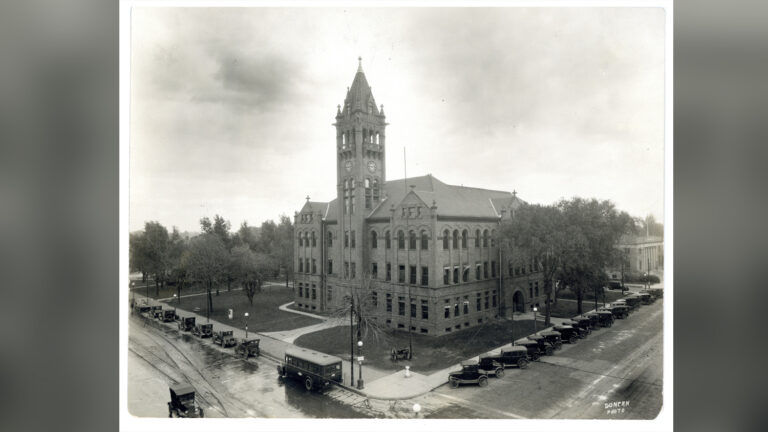
URBANA — Since 1901, the Champaign County Courthouse has gone through immense changes, from the building itself to the way it functions in the community.
But changes at the state level in recent years have led to a sharp decline in revenue, raising some concerns about the financial future of the courthouse, which is part of the Sixth Judicial Circuit of Illinois.
The courthouse building celebrated 125 years in August and is the fourth iteration of courthouses for the county.
Susan McGrath, Champaign County circuit clerk, said throughout the 1800s and 1900s, the courthouse was a source of entertainment for residents of the county — “a place where people would gather to see what was happening in the community.”
“People wanted to know, Farmer Jones might be suing somebody because his cattle got stolen, and it was a vital part of how the community operated,” she said, “because without the rule of law, your community can’t move forward in a lot of different ways.”
That sentiment still rings true today, she said, as the tradition of community members watching courthouse “entertainment” hasn’t changed.
“It’s not quite the way it used to be,” she said. “But there are still people who do come to see what’s going on here, and they should be entitled to that.”
The courthouse plays an important role in the community, McGrath said, but she worries about the sharp decline in revenue resulting from a state law that took effect in 2023 that eliminated cash bail, among other changes.
“I think anybody who cares about what the county provides to citizens has to be concerned about the financial situation we’re in right now,” McGrath said.
A bit of history
The first courthouse for Champaign County was a makeshift log cabin and only held two sessions of court in 1836 and 1837. It was replaced twice in 1840 — first, with a brick and wood frame building, followed by a steel-framed courthouse with a masonry exterior.
The current courthouse, completed in 1901 for $150,000, was designed by architect Joseph Royer.
The original structure included a 135-foot clock tower that was struck by lightning at least four times, which led to the loss of its steeple in 1930 and belfry, which hung the bells, in 1952.
In 1996, a study conducted by an engineering firm found the building was too small, the layout was poor and it did not conform to ADA requirements. A subsequent expansion added an East wing with three stories and eleven courtrooms.
Visitors can still walk on the old courtroom’s marble floors. And on the first floor of the old courthouse, there is a dedicated Lincoln showing room.
Here, community members can watch a film about Abraham Lincoln’s life, and see old memorabilia, like the original pamphlet dedication of the courthouse, a key to a door of the previous courthouse iteration and a quilt sewn with all the townships in Champaign County.
An uncertain financial future
The courthouse, McGrath said, touches on so many aspects of people’s lives.
“It’s important to people to be able to do what they need to do either to get their lives back in order again or to take care of their business or to help somebody in their family,” she said.
But lately, she’s been worried about the financial future of the circuit court.
The Circuit Clerk’s office is primarily funded by user fees, including filing fees. With the passage of the Pretrial Fairness Act in 2021, Illinois eliminated the cash bail system and created a pretrial release system in which people are no longer required to pay to be released before trial. The law took effect on Sept. 18, 2023.
McGrath says when she took her position in 2020, her office was receiving about $3 million in fees. It has now decreased to about $1 million, largely due to these changes.
A possible solution would be raising the county’s property taxes. However, Champaign County is not a home-rule county, meaning it cannot raise taxes without going to voters for a referendum, she said.
McGrath says the Illinois legislature and Supreme Court expect the county will fund their operations, but as of right now, the county has not replaced the lost revenue.
In an email response to questions for this story, John Farney, Champaign County board member and vice chair of the finance committee, said the actions of the Illinois state legislature and governor over the past five years have been “an absolute nightmare for counties in Illinois.”
He said there’s not much the county can do to increase revenue to the circuit clerk’s office since many of the fees for services of the Circuit Clerk’s Office are heavily regulated by state statute or rulings of the Sixth Judicial Circuit
The state legislature has reduced or eliminated many of the fees that counties have traditionally relied on for revenue, Farney said, and “did not identify any new means of generating revenue for counties to help operate the criminal justice system.”
Champaign County also has a cap on how high the courthouse can raise its filing fees. However, if a resident can’t pay the fee, it will be waived anyway.
“So if it’s raised to a point where they can’t pay it, then we’re not really making any extra revenue,” McGrath said.
She said the state legislature recently addressed the financial needs of the public defender’s office, separating it from the rest of the circuit court, where it will have an independent budget among other changes.
“But honestly, that needs to happen for every office that’s in the courthouse,” McGrath said. “We cannot be operational with 100% from filing fees. That’s just not going to happen.”
She says one way or another, it will be important for leaders to find a path forward, since the courthouse plays an important role in people’s lives.
“The fact is, when people talk about access to justice, access to justice means people have to be able to come to the courthouse and do their business,” McGrath said.