
CHAMPAIGN — Naloxone is a lifesaving medication that reverses opioid overdoses and is supplied to communities across Illinois through public health agencies and other entities. The state of Illinois recently switched from providing the brand name Narcan to a generic known as Padagis.
Health officials say the switch to a generic form of naloxone will save money and increase the supply of the lifesaving medication across the state.
Joe Trotter, harm reduction coordinator at the Champaign-Urbana Public Health District, said there are no major differences between the two nasal sprays. The district announced the change in July.
“It has a different name and different colors on it, but otherwise it’s the exact same product, works the same way, is applied the same way, and has the same results,” he said.
Naloxone attaches to opioid receptors in the brain and blocks the effects of opioids; it can restore normal breathing to a person whose breathing has been slowed or stopped due to an overdose.
In Illinois, the purchase of naloxone is funded through federal grants allocated to the state.
In FY2026, state data shows 43,000 people have been trained to recognize the signs of opioid overdose and respond by administering naloxone, and more than 442,000 naloxone kits have been distributed by organizations enrolled in the state’s Drug Overdose Prevention Program.
Trotter said the state handles all the funding, so the switch to generic naloxone has not directly affected the district’s savings. Rather, naloxone is simply easier to get and cheaper.
Harm reduction in Champaign County
The Harm Reduction Program at C-U Public Health aims to prevent overdoses, by providing naloxone, along with training and education. Additionally, the district provides sterile syringes and other supplies to reduce the risk of injection drug use.
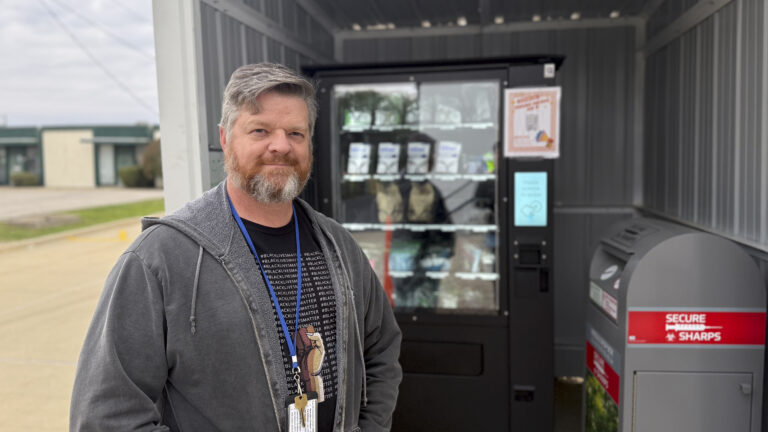
Harm reduction supplies – including naloxone, syringes and tourniquets – are available through C-U Public Health by delivery or through a vending machine outside of the district’s office.
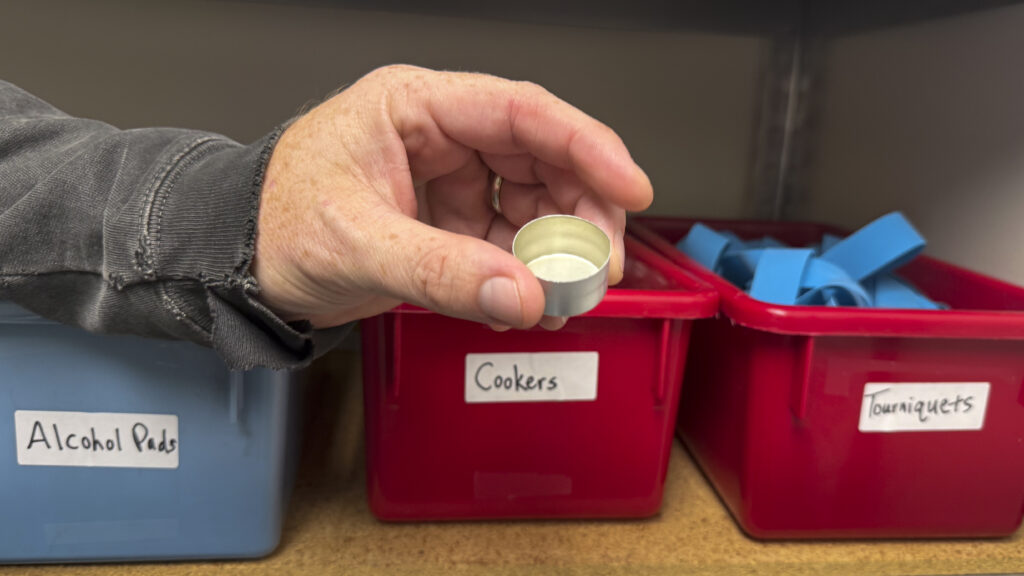
To access these services, a person must fill out a form on the district’s website. The form asks for a person’s initials and prompts them to create a four-digit pin and select the supplies they want. Then, Trotter said he’ll deliver a concealed box with the items at a location of the person’s choosing.
Anyone over the age of 18 can consent to receiving syringe services and other supplies, according to the Illinois Overdose Prevention and Harm Reduction Act.
C-U Public Health is also starting an Overdose Fatality Review team, which will examine opioid overdose deaths that naloxone did not prevent, with the goal of identifying where the district’s services fell short, according to district spokesperson Tanya Giannotti.
“It’s a matter of looking at in-depth cases and looking at them in a multiple disciplinary way to be able to say: ‘What could we have done different?’” Trotter said.
He said the team is in its early stages and does not yet have findings to share.
Reaching neighboring counties
C-U Public Health also operates a harm reduction coalition known as the Partnership to Reduce Opiate Mortality and Promote Training (PROMPT).
The coalition, supported by a state grant, allows the district to distribute naloxone and coordinate overdose prevention methods to 10 counties, including Vermilion.
Emily Ahmed, the Vermilion County Health Department’s community health planner and emergency preparedness coordinator, said Carle Health’s community outreach team has a bigger role in distributing naloxone in the county than her department does.
“Carle, in general, has more resources for that sort of thing, so they definitely have a bigger role in it than we do,” Ahmed said.
As part of her work in Vermilion County, Jenny Gomez, a Carle Health community outreach worker, said she sets up tables with naloxone at community events.
Gomez said hostility toward naloxone used to be very strong in the community, but it is gradually improving.
“Three years ago you did not see naloxone in Vermilion County anywhere. Now we have over 30 businesses that have it sitting on their counters for people to take for free,” Gomez said.
Combatting stigma
Todd Beard, manager of Carle Health’s Addiction Recovery Center, said that the stigma around drug use isn’t limited to Vermilion County.
“If you turn on the TV, you will still see stigmatizing language used to discuss people who have a substance use issue and a lot of mixed messages about what is harm reduction,” he said.
Substance use treatment can also feel stigmatizing, he said. People who come in wanting to change may feel judged when a program takes a strict approach to recovery.
Beard said Carle’s approach is to meet people where they are.
“When you show up for the person seeking care and when they don’t feel judged, they tend to come back at a higher percentage and they tend to stay involved at a higher rate,” he said.
Gomez said building relationships is the key to reaching people who use substances. She mentioned that some people turn down naloxone because of what they think it says about them.
“People say things like, ‘I don’t need that, I don’t do drugs, I’m not one of those people,’” she said.
But, she noted, people often take prescribed opioids and do not know realize they are taking opioids that carry severe risks and side effects, such as unintentional overdose and withdrawal.
Once a patient develops a tolerance to an opioid, it puts them at a higher risk of developing a physical dependence or even a potential fatal overdose, according to the U.S. Centers for Disease Control and Prevention.
At events, Gomez said she keeps a list of commonly prescribed opioid medications to share with people who may not know they are taking opioids.
“The greatest combat to any stigma is education,” she said.