

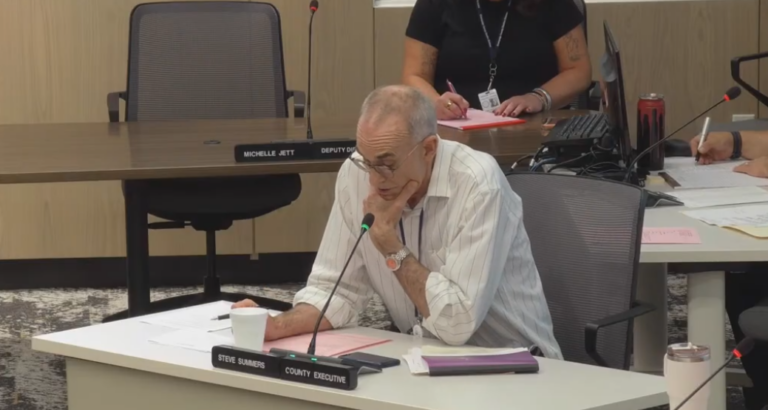
URBANA – An attempt to pass home rule in Champaign County Monday night was cut short when a bipartisan group of county board members left the meeting early, forcing the meeting to end after three minutes and before any member of the public could comment on the issue.
Champaign County Executive Steve Summers called the special board meeting last week, with the intent to vote on putting the issue of home rule on the November ballot. Residents and some elected officials have championed the county gaining home rule status as the only way for the county to permanently ban data centers. The county currently has a moratorium on data centers that ends next spring.
There needs to be a majority of board members present for any business to be conducted, according to the board’s rules and procedures. The walkout left the meeting with less than 12 members.
“As we do not have a quorum, we cannot move forward with said business,” Summers said, “so I am going to call this meeting adjourned.
Republicans made up the majority of the members that left. Brett Peugh of Champaign was the only Democrat that joined them. Board member John Farney of St. Joseph organized the walkout.
“The meeting tonight was called very hastily. It was last minute, because there was a deadline to do this,” he said. “So no real thought went into the process. Board members lacked information.”
Board Vice Chair Emily Rodriguez, who also chairs the county’s data center task force, wanted the chance to vote on the issue.
“To me, it was important, because I know that I’ve heard so often from constituents and members of my district and people who show up at task force center meetings, to at least have the option of voting up or down banning data centers,” she said.
It is not clear if the county even needs home rule to have the authority to ban data centers, Farney said.
“One of the things we do not have is an opinion from our state’s attorney that says yes we can ban data centers, no we can’t ban data centers,” he said. “We don’t have that information.”
But Rodriguez argued the board does have that information.
“There is no question. We cannot ban data centers without home rule. We simply cannot,” she said.
Champaign County Executive’s Office Director of Administration Michelle Jett has also confirmed the county doesn’t have the authority to ban data centers.
“You have to be home rule in order to have the legal authority to outright ban some kind of business or industry,” she said at an anti-data center meeting last week.
The county’s current data center moratorium is in place to allow the Data Center Activities Task Force to create new guidelines for future development.
“I’d like to see the work of the data center task force be completed,” Farney said. “I’d like to see what they come up with, so we have actual rules and ordinance in our zoning ordinance to actually regulate what were to happen if someone wanted to build a data center in Champaign County.”
If the issue of home rule is brought before the county board again, Farney would likely still be against it.
“I’ve been told that it means that county boards can raise taxes pretty much however they want to. I don’t like that idea,” he said. “I don’t trust us, myself included. Any time you give a government entity the chance to raise taxes, they’re gonna be tempted by it.”
Home rule does give local governments greater flexibility over finances and the option to implement revenue policies that reduce reliance on property taxes, according to the Illinois Municipal League.
Home rule could bring positive opportunities to the county too, Rodriguez said, especially when it comes to working with future developers.
“For example, we’ve talked about community agreements that would require developers to invest in apprenticeships for the trades, for local schools,” she said. “We can’t do that without home rule we’ve discovered.”
Home rule would also give the county more authority over building, zoning, sanitation, nuisance abatement, civil disturbance and certain criminal offenses, according to the Illinois Municipal League.
Cook County, home to Chicago, is currently the only county in Illinois with home rule status, according to the Illinois Association of County Board Members.
“I would like things such as being able to regulate public nuisance laws in Champaign County,” Rodriguez said, “So for example, if you have a landlord who’s allowing mold to grow rampant in your apartment building, in some pockets in the city of Urbana, we can’t do much about it.”
The state has largely declined to take up the issue of regulating data centers so far.
Gov. JB Pritzker called on state lawmakers to pause the state’s data center tax incentive in his state budget address this year. They introduced measures to regulate the growing industry that failed to pass out of the General Assembly.
Pritzker paused the tax incentive himself and released a framework to regulate data centers, calling on lawmakers to take up the issue during the November legislative veto session.
“We are not confident in the statehouse’s ability to pass something at this time,” Rodriguez said. “We’re also down a state legislator to represent our interests in Champaign.”
State Rep. Carol Ammons (D-Urbana) is currently facing federal charges of wire fraud and obstruction of justice. She has been temporarily removed from House Democratic Caucus meetings and House committees while a House committee further investigates her actions.
Rodriguez has been talking about home rule since she first ran for county board in 2020, she said, and she thinks the debate is not over.
“I think Republicans in this county get so few options for big wins, and I’ll give it to them this time,” she said. “They organized, they did their best, and we didn’t have a quorum because of them.”
Six of the 22 seats on the board are occupied by Republicans.