

This story is part of America @ 250: The Questions Before Us, a series from IPM News and the Illinois Student Newsroom.
CHAMPAIGN — A birthday is a time for celebration and reflection: Where have we been? Where are we right now? And where are we going?
IPM is marking America’s 250th birthday by inviting people from across east-central Illinois to share what they think are the most important questions facing our nation at this historic moment.
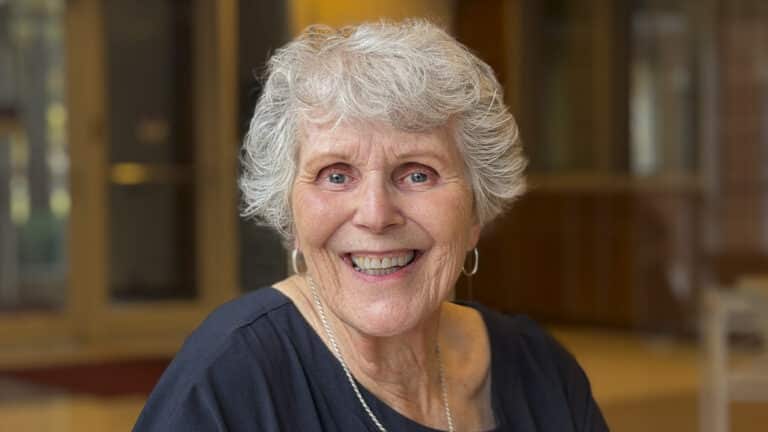
Champaign resident Ann Prisland has worked to register over 3,000 people to vote since 2016. Most of that work has been done through the Champaign County League of Women Voters, where she leads the Voter Ready Team.
Prisland has also served as a Champaign County election judge since 2008.
The following transcript has been lightly edited for length and clarity.
‘I’m not into politics.’ ‘Politics has nothing to do with me.’ ‘I don’t vote because they’re all corrupt.’ ‘My vote doesn’t count.’
Some people say, ‘I just don’t have time to even think about it.’ And, ‘The only time I see politicians is around election time when they want my vote and then they ignore me.’
Those are a whole laundry list of reasons for why people don’t vote. Many of them are valid.
And that’s what I think the election of 2026 is all about. People are hurting. There’s a feeling that government is not working. But government is who we elect. So we have to figure out a way so that who we’re electing is actually doing what it is we want them to do.
We’re just a week or so past the 2026 midterm election, and about 61% of registered voters voted in Champaign County. There are two ways to think about that. One way is to say ‘Only 61% voted.’
The other way to think about it is, ‘Gosh, 61% voted in a county that’s part of a very gerrymandered district in a gerrymandered state. But people still wanted to make their voices heard, and they wanted whoever got elected to know that they were out there and were voting.’
Contrast that with what happens in a typical municipal consolidated election, where we’re talking city councils, school boards, other boards here in the county. Turnouts in those elections are much lower. For instance, in the last municipal election, only 19,187 of the registered voters actually voted. That’s a miserable 14%.
People think, ‘Oh, gosh, what does it matter who’s on my city council?’ Well, it matters a whole lot — from property taxes to school issues to potholes to pretty much everything. And those are the people that we can actually have an impact on.
It makes a lot of sense when you think about it, because the people who are serving in the city councils or county boards, they’re your neighbors. You can call them up. You can meet for coffee. They’re available. They actually — most of them — welcome it, because they want to hear from their constituents.
Where there are fewer voters, one can argue that your vote has more impact. I’ve never had a local member of any of the city or county governments that I’ve asked for a meeting turn me down.
Voting is viewed by many people as an event. I think it’s really important for us to start thinking about voting not as an event that just appears and disappears one day during the year, but as part of our culture. We need it to be discussed in schools. We need it to come from cultural leaders as well as folks who are actually involved in the governmental process, from the president on down.
So if we want to keep our democracy strong, then I think the question we need to ask ourselves is, ‘How do we change our understanding of voting from an event that happens once a year to being part of our culture — an integral part of our democratic culture?’
This story was reported by University of Illinois Journalism Professor Charles “Stretch” Ledford. If you have an idea for the America @ 250 series or would like to be featured in an upcoming story, please contact Stretch at stretch@illinois.edu.