

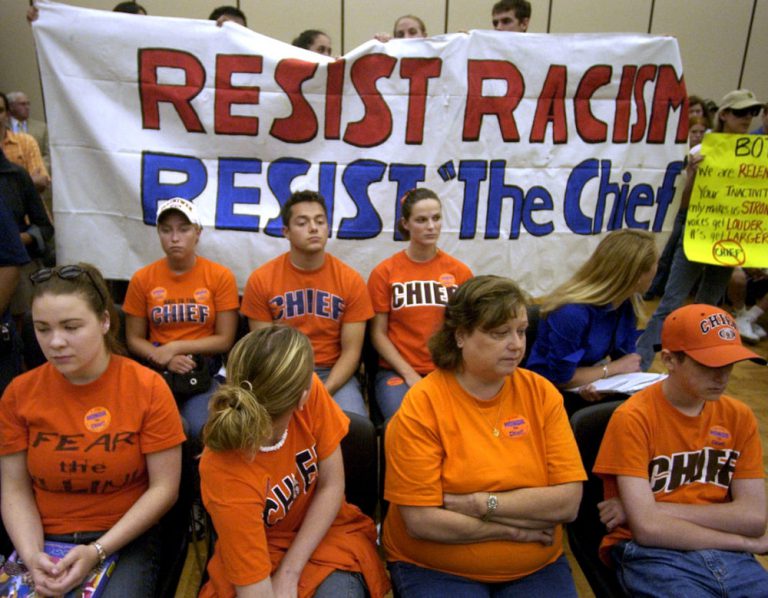
CHAMPAIGN — Following the 100th anniversary of the debut of Chief Illiniwek, some Native American students and faculty at the University of Illinois Urbana-Champaign have faced harassment by those who would like the university’s longtime mascot to come back.
The fictional Native American chieftain was U of I’s athletic symbol until 2007 when the school retired it under pressure from the National Collegiate Athletic Association. Supporters have long said the Chief honors Native Americans.
“Literally in the same breath, they’re saying this symbol is about respect and honor, and by the way, ‘You’re cuss word, cuss word, cuss word,’” said U of I history professor Rosalyn LaPier.
LaPier is a member of the Blackfeet Tribe of Montana and Métis. After the Daily Illini interviewed LaPier for an article about the 100th anniversary, comments attacking her and calling for her termination proliferated on social media.

LaPier said their experience shows that it does the opposite, that it encourages prejudice towards Native Americans, just as research has indicated and as earlier generations of Native faculty and students have said. In 1994, Native students and faculty filed a federal civil rights complaint saying the Chief creates a hostile work environment.
Fellow history professor Yuridia Ramírez brought the issue up Monday at the U of I Annual Meeting of the Faculty. Ramírez said certain Chief supporters were repeatedly contacting and harassing LaPier, the Native American House and others. She said the university needed to make a statement, similar to what it has done in the past condemning incidents of antisemitism.
“The persistent communications targeting our Native community members were harassment, yet when emails alerted you that this was happening, you said nothing,” Ramírez said to administrators.
In response, campus officials said they acknowledge that “Chief Illiniwek” caused harm.
“I want to also indicate that we as an institution recognize the harm that Native American imagery has caused to our Native American students, staff, faculty, and I’m doing it right here,” said Interim Vice Chancellor for Access, Civil Rights, and Community Gioconda Guerra Pérez.
Guerra Pérez said the campus has to be careful about protecting free speech, but that the university is working on the issue. She said one project is adding a module to the bias and discrimination training for staff and new students on the harm Native American imagery has caused students.
While chancellor acknowledges Chief Illiniwek is problematic, not ready for new mascot
A student present at the meeting asked the U of I chancellor to adopt the student-created mascot, the Kingfisher, to end the issue.
Chancellor Charles Isbell said that while “Chief Illiniwek” caused harm, a new mascot isn’t on the way.
“I don’t think creating a new mascot will immediately put everything else to rest. We know we have lots of evidence that suggests that whenever we have these kinds of conversations, it actually increases the number of people who want to go backwards,” Isbell added. “That doesn’t mean that we don’t do it and we don’t do it eventually, but it is a reality.”
Isbell gave an example of an Uber driver he met in San Diego, who attended U of I and upon learning Isbell leads the institution, asked why he hasn’t brought the Chief back. Isbell said they then talked for 45 minutes, and he tried to convince the alum why that would not work practically and why it would hurt so many people.
He said that the driver thanked Isbell for the new perspective at the end of the ride, even if he wasn’t sure he had changed his mind.
“I do think we have to have the conversation. I do think that we have to deal with it for real, and hopefully we will get to a place where everyone understands one another and we can move forward in whatever way makes sense to move forward.”
Isbell said U of I and the Peoria Tribe of Indians of Oklahoma are exploring creating a center on campus for collaboration on research, education and economic development, similar to the Myaamia Center at Miami University in Ohio. He said he hopes that will also help the university community have conversations about the symbol’s legacy.