

CHAMPAIGN — Across the country, data centers are transforming rural landscapes, particularly those with abundant water sources and reliable energy grids. Cornfields give way to massive buildings humming with servers and drawing gallons of water every second.
Champaign County officials want to be ready for the possible arrival of new large-scale data centers in east-central Illinois.
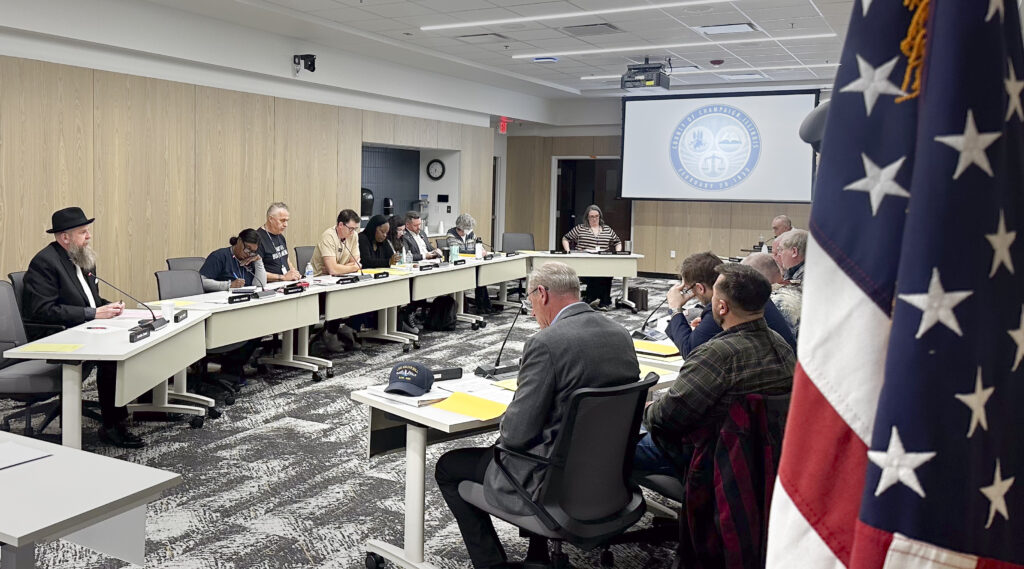
The County Board voted unanimously Thursday night to create a data center task force. In parallel, Champaign County is working to implement a 12-month ban on the construction of new large-scale facilities.
The data center task force will develop zoning and permitting standards for unincorporated land in Champaign County.
Protecting local water resources will be a key focus of the new task force, said Michelle Jett, Champaign County’s director of administration.
We want “to make sure that we’re protecting Champaign County and our resources and that we’re doing something thoughtfully and we’re thinking through all the concerns,” she said.
The urgency is real, said Emily Rodriguez, vice chair of the Champaign County Board and incoming chair of the task force. She said the region is already on the map.
“Central Illinois is a particularly attractive area to build data centers,” Rodriguez said. “Our energy consumption is pretty stable, and we have, at least on paper, the capacity to supply such a need…and we know that there’s interest in building data centers in Champaign County.”
This county-level initiative is taking place as state lawmakers consider steps to regulate the growth of high-tech data centers, in an effort to shield consumers from rising electricity costs and protect the state’s natural resources.
A moratorium would give the task force time to explore the issue
Alongside the task force, the county is also working with the Zoning Board of Appeals to implement a 12-month moratorium on data centers of at least 10,000 square feet.
This is a separate step, but the goal, Jett said, is the same: “to give the task force time to figure out what the permitting, permitting requirements do need to be.”
Rodriguez emphasized the importance of creating regulations around data centers’ usage of the Mahomet Aquifer, which is the the primary source of water for roughly 800,000 people stretching from Iroquois County to Cass County.
It’s also important to consider the potential tax revenue and economic growth that could come with the arrival of new data centers.
“I hope to sharpen our policy on creation of data centers in Champaign County,” she said. “We want something that works for our neighbors and our aquifer in particular.
Jett said she shares concerns about protecting the Mahomet Aquifer – as well as local energy resources.
“It takes an enormous amount of water to cool the servers. Where are we going to get that water from? It can’t only come from wastewater from the cities,” she said.
“I’m also really concerned about our energy use… all of these are contextual factors really leading into this issue, not just for me and my district, but people growing up in this area and what their lives will look like 20 years from now.”
Local concerns about large-scale data centers
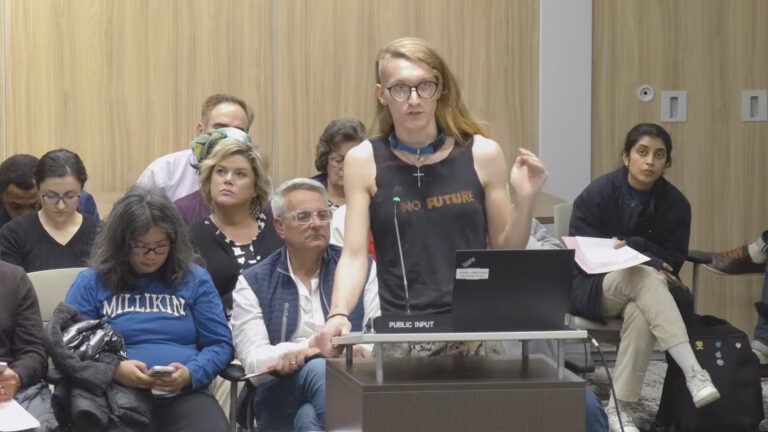
Alice Smith, a first-generation farmer at Sola Gratia Farm in Urbana, came to the County Board meeting to support the idea of the task force and warn against data center construction.
“I think it’s a really bad idea to build data centers in Champaign County,” she said, citing water depletion, energy use, and what she sees as a questionable investment.
Proponents of new data centers cite local economic benefits and job generation. Smith said she doesn’t believe that’s really viable.
“Those are the exact same arguments they made about cryptocurrency in 2022, and look at how well that worked out,” she said. “You get construction jobs and a tiny number of maintenance jobs, and that’s it.”
Jett said the process of discussion and review is what matters most about the task force.
“This is the opportunity for you to tell the County Board how you want your county to look going forward,” she said. “Once the permitting parameters are put into place, it’s going to be much more difficult to make changes.”