

Updated on Monday, March 2 at 12:00 p.m. CT
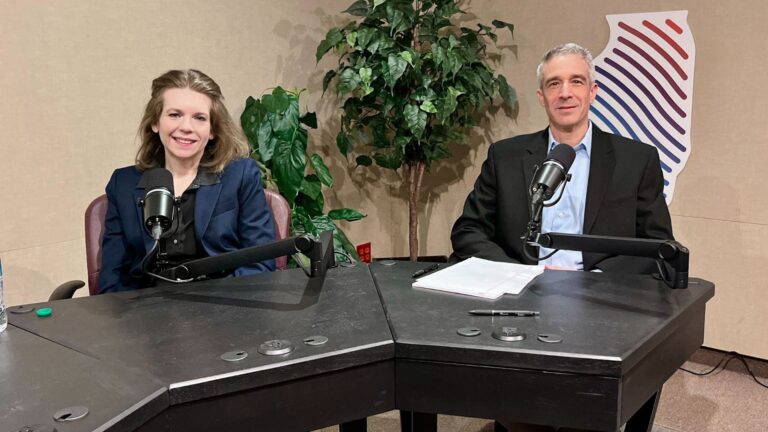
URBANA – The two Democrats running for Champaign County Executive shared their views on data centers, federal immigration enforcement and whether the position of county executive should be appointed or elected, at a candidate forum hosted by IPM News.
Michelle Jett and Sanford Hess are competing in the Democratic primary on March 17.
Jett has over a decade of experience in government, including state politics and local public administration. She has worked in Champaign County for more than six years – and has been director of administration for about two and a half years in the County Executive’s office.
Hess has worked with local government administration for over 30 years, including as a government consultant, City of Urbana IT director as well as member of the Mayor’s cabinet and a division manager.
With no Republican in the race, the winner is expected to take the office of County Executive, replacing incumbent Steve Summers.
The forum, recorded on Feb. 10, was hosted in partnership with the League of Women Voters of Champaign County and the National Association of Advancement of Colored People (NAACP) of Champaign County. The conversation was moderated by IPM News Senior Editor Arjun Thakkar.
Data center regulations
Champaign County Board members are considering a one-year moratorium on new large-scale data centers so that they can develop zoning regulations. The Board is set to vote on the creation of a task force to explore the issue at its Feb. 19 meeting.
Data centers require a lot of energy and water, raising concerns about the environmental costs. Since the Mahomet Aquifer is the county’s sole source of drinking water, Jett said the county needs to approach the issue slowly and with caution.
“This is going too fast, and we need to slow down,” she said. “Champaign County has more responsibility on this than most other counties, because we have so much of the Mahomet Aquifer in our county… Protecting the aquifer is the item that unifies everyone in this county.”
Hess agreed the county has taken the right approach in slowing down, but he noted that data centers could also benefit the county financially.
“Something that is worth considering is that there are revenues coming in from data center use,” he said. “At the same time, it’s important that we consider the bigger picture: their use of water, their use of recirculated water, or their use of water that is not recirculated.”
Immigration enforcement
Champaign County Board member Matt Sullard recently proposed a ban on hiring people who have worked for U.S. Immigration and Customs Enforcement.
When asked how the county should respond to federal immigration enforcement, the candidates took different approaches.
Jett openly criticized the Trump administration.
“Speaking for myself and for our County Executive Summers, we believe that what Trump is doing with ICE is nothing short of domestic terrorism,” she said, noting that a county executive order is in the works “regarding the county’s stance on this issue.”
Jett said they’ve been working closely with local immigrant groups “to make sure that we are considering their safety, their priorities, and their input.”
Hess said there are a lot of gray areas when it comes to issuing a ban on hiring people with prior experience working for ICE.
“What about somebody who worked in an office position? What about somebody who’s served in the past but has not been part of the federal enforcement that we’re seeing going on right now?” he said.
He said local governments have a limited ability to respond to immigration enforcement. He maintained that safety should be the county’s top priority.
“We should be having discussions and doing everything that we can to make sure that our community feels safe,” he said.
Differing views on election vs. appointment of the role
Champaign County is one of just two Illinois counties where the County Executive is elected, not appointed. The candidates disagreed on whether this should be changed.
Hess said he supports putting the question up for a vote.
“I just believe that the long-term interests of the county are better-served with a professional in this position, instead of a politician,” he said.
Jett argued the position should remain elected, referencing the Trump administration and concerns about accountability.
“What I’ve seen most starkly from the Trump presidency is the danger of having appointed people that we don’t know enough about,” she said. “By making it an elected position, it forces the people who want to be in the position to tell the voters who they are and what they stand for, what they believe in.”
Addressing residents’ concerns
Both candidates acknowledged hearing concerns from residents about federal-level issues.
Jett said she hears a lot about federal issues and the presidency.
“Everyone’s very concerned about the presidency…and just the corruption and hatred that is coming from the White House,” she said. “I know, as county executive, I would be working, daily, diligently as my priority, that what is happening on the federal level is not happening here.”
Hess said he has also heard concerns about local issues, like taxes.
“Property taxes are high, sales taxes are high, and people are concerned about increasing taxes on top of what they’re already paying,” he said.
Jett rebutted, saying, “The Champaign County tax rate has dropped eight of the last 10 years. The county is consistently taxing at a lower rate year over year.”
According to Champaign County’s Budget Book for FY2026, the county property tax rate has been trending downwards, from 0.8481 in 2017 to 0.7890 in 2024.
Hess also mentioned his own concerns about federal funding from the American Rescue Plan Act, or ARPA, COVID-era funding that will run out by the end of the year.
“What we’re not seeing is enough planning about what that next stage is going to look like after that funding is gone,” he said. “It’s important to acknowledge that there are ways that we can protect our local community, and there are ways that we can communicate with people to explain what we’re doing.”
Early voting is now open and the primary election is on March 17.
CORRECTION: This article has been updated to correct how many years Michelle Jett has worked as director of administration for Champaign County.