


TOLONO — Aaron Slayton lives and works at Five-Acre Farm Daylilies a few miles outside of Tolono, with their husband, Jim Wuersch.
They first came to Illinois in January to visit and help him deal with the grief of his late husband’s death. After helping around the house and farm for a few months, Wuersch asked Slayton to move in permanently.
“I technically never went back home after coming down,” they said.
Slayton had begun saving money to move out of Tennessee in 2022, but they were forced to put those plans on hold after they were raped and contracted HIV, which progressed into AIDS.
“Most of that [money] was spent on paying off the rest of my rent from when I was hospitalized,” they said.
Slayton is nonbinary, and while the move to Illinois this year was somewhat spontaneous, they said part of their decision to stay came from an increase in discrimination they experienced as a transgender person in Lebanon, Tennessee.

Across the U.S., legislators have introduced hundreds of bills limiting gender-affirming care and restricting transgender people from public life. It’s causing some to choose to leave their homes in search of safer and more affirming communities.
In Tennessee, many laws restrict LGBTQ+ identity and gender expression. It was ranked among the lowest-rated states on the Human Rights Campaign Foundation’s annual State Equality Index report, which reviews legislation impacting the LGBTQ+ community.
But in addition to anti-trans legislation, the broader debate around transgender identity has become more hostile, creating a widespread sense of fear among many trans people.
Slayton said they weren’t welcomed at gendered support groups for victims of sexual violence, they were turned away from food pantries operated by Christian churches and they were often harassed in stores or restaurants they frequented in Nashville.
“There were a lot of times that I just didn’t feel safe,” they said. “So I kind of quit going.”
Slayton said the current rhetoric from the Trump Administration and conservative politicians has emboldened people to harass trans people in public.
“They don’t think that it is discrimination to blatantly say transphobic things,” Slayton said. “So there were places in public settings where if somebody recognized me as being trans, it was putting me in danger, because they felt a need to throw me out of whatever public place I was in because I didn’t belong, because somehow I was a threat.”


In search of safer communities
A recent survey conducted by the Williams Institute, a think tank at the UCLA School of Law, suggests Slayton’s experience isn’t uncommon.
The study found 48% of transgender, nonbinary and gender-diverse U.S.adults said they’d considered moving or had already moved to a more trans-affirming place. Respondents all cited concerns about hostile policies and the intense sociopolitical climate as reasons for wanting to move.
Children and teens who are trans face even tighter restrictions in many states, mainly in the form of health and education policies like those restricting access to gender-affirming care, preventing participation in competitive sports or requiring teachers to get parents’ permission to use a child’s preferred name and pronouns.
Illinois has become a target destination for some of their families, as one of four Midwestern states that has not banned gender-affirming care for minors.
Asher McMaher sees this playing out in real time. They are the executive director of Trans Upfront Illinois, a nonprofit that advocates for trans people ages 4 to 25.
“Our organization serves anyone in the state or anyone who comes into the state to access care,” they said. “Right now, we serve about 900 families. About 250 of those are from surrounding states.”
McMaher said families are worried about their children’s safety if they can’t access the care they need.
“We know gender-affirming care is lifesaving, and they’re worried that they’re going to lose their child,” they said.
Federal laws threaten gender-affirming care
Research indicates that gender-affirming care – including medications like puberty blockers and hormones as well as social aspects like using a different name and pronouns – improve the mental health of trans and nonbinary youth.
A 2024 report by GLAAD, an LGBTQ+ advocacy nonprofit, compiled 35 statements from leading medical associations and health authorities in support of gender-affirming care.
But even in a state with trans-affirming laws, federallaws and executive orders can still make it challenging, especially for minors, to access certain kinds of care, said Joshua Gavel, executive director of Uniting Pride of Champaign County, a nonprofit LGBTQ+ resource center.
“It’s really scary right now, the stuff that they’re doing at the federal level to specifically go after hospitals and threaten, you know, millions of dollars in needed funding, especially for rural hospitals,” he said.
In February, Lurie Children’s Hospital in Chicago announced it would pause gender care surgeries for people under 19 after threats to funding from the Trump Administration.
President Trump signed an executive order on Jan. 28 describing gender affirming care as “chemical and surgical mutilation” and declared that the government would not fund or support medical transition services.
Gavel said with care getting more difficult to access, “it’s a tough situation, and I think we’re going to see families making hard choices for a while.”
More than just health care
But health care isn’t the only thing that draws trans people to Illinois. Gavel said the schools are a big motivation for families with trans children, and the cost of living is much lower than in major cities like Chicago.
“We have seen a huge uptick in folks moving to this area, especially trans and gender-nonconforming folks,” he said.
Gavel shared that many local politicians, business owners and medical institutions are also LGBTQ-inclusive, creating a sense of community support for trans people who live in the area.
“Just knowing that there [is] such a cool bubble of resources that are affirming is a huge win,” he said. “I mean, we host the largest Pride festival in the state of Illinois outside of Chicago.”
Gavel also said the city’s queer-friendly religious groups have a unique appeal for those who have typically been excluded from faith because of their identities.
“There’s been a lot of damage done in organized faith spaces over the various millennia, and we need faith spaces to reckon with that,” he said.
In particular, Gavel pointed to the Unitarian Universalist Church of Urbana-Champaign, where Slayton and Wuersch are active members, volunteering almost every Sunday.
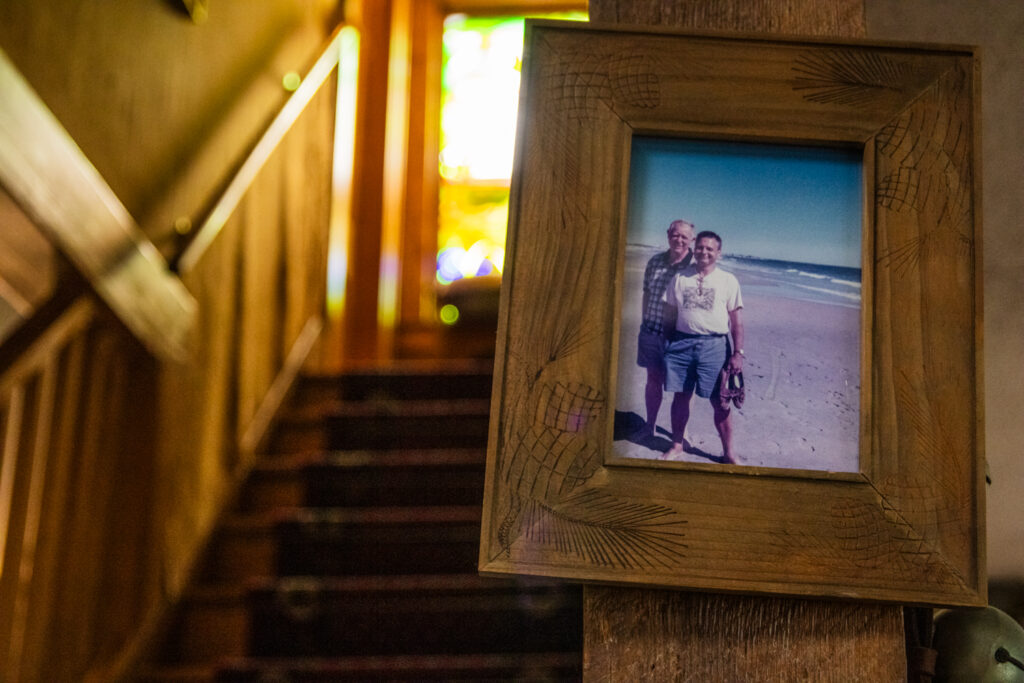
They also participate in the church’s queer group, where Slayton said they have enjoyed meeting queer members of the church and joining in social activities and community service projects.
“It has really helped me to be able to sort of act as a segue into the wider community,” Slayton said.
UUCUC is a trans-affirming congregation that regularly participates in protests, Pride events and lists social justice as one of its eight principles of belief. Slayton said they feel free to openly identify as nonbinary and express their gender as well as practice their pagan beliefs in community with others.
They said what the church offers is more than just empty words.
“What will make a difference and what will impact people is knowing that they have a community that actually cares about them,” Slayton said.