

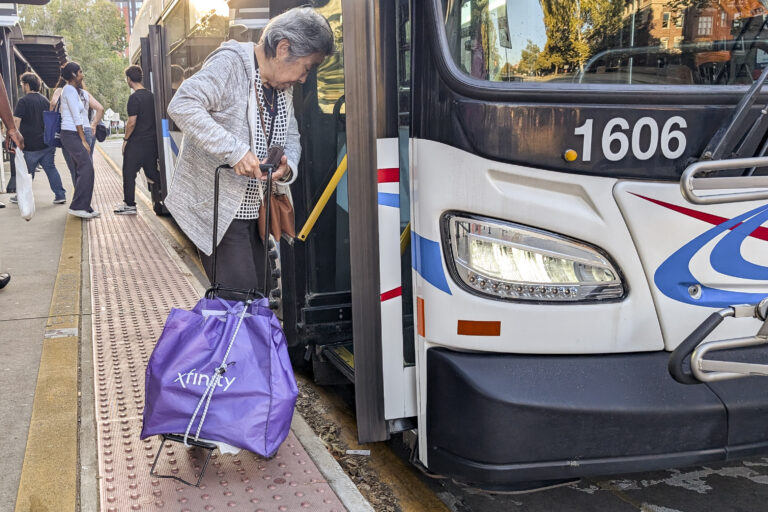
URBANA — Illinois transit agencies are facing funding shortfalls that could lead to service cuts and layoffs — an issue lawmakers are expected to address during the fall veto session beginning this week.
Last May, Illinois lawmakers passed the state fiscal budget for 2026, totaling $55.1 billion. But the budget did not account for expiring public transportation COVID-19 relief funds, resulting in a $200 million deficit for 2026 finances.
The deficit is expected to increase to $790 million by 2027 if not addressed soon, according to the Regional Transportation Authority’s website.
The Illinois Constitution established access to public transportation as an essential public service for which funds may be expanded.
State representative Carol Ammons (D-103) says she supports finding a solution for the deficit. She said it is now the state’s responsibility to fund expenditures previously covered by federal relief funds.
“Transit is on the docket for us at the veto session,” Ammons said. “The Northern District is the most difficult right now, but we know in 2026 we’re going to be facing a similar transit cliff that we are working on right now. We do have a working group that is looking and working on some solutions with our transit authorities.”
Amy Snyder, the Champaign-Urbana Mass Transit District’s deputy managing director, said the deficit will not take immediate effect on Champaign-Urbana’s MTD.
But it may be a problem if a solution is not reached in this fall veto session or next year’s fiscal budget, resulting in route cuts, fewer buses and layoffs.
“We wouldn’t have to pull back yet,” Snyder said. “But we would be pretty close, because we’re cutting the margins so close with the revenue against the expenses. We could be, down the road, in a situation where things get tight.”
Transit funding shortfalls are caused by a combination of necessary spending outpacing the growth of state sales taxes, local sales taxes becoming stagnant, in addition to the expiration of federal relief grants.
Laura Calderon, the executive director for the Illinois Public Transportation Association, said the funds to bridge the gap could come from moving existing state sales taxes around to the Downstate Operating Assistance Program.
But she said the governor’s office has pushed back on that because it would impact general revenue; so the money would have to come from a new fee or an increase in an existing tax.
“I think eventually legislation will be passed to bridge the funding gap. We hope to see that happen in the veto session,” Calderon said. “We are hopeful that the legislature can get together and negotiate a reasonable compromise to bridge that funding gap.”
The Illinois House’s Transit Working Group, which is tasked with addressing state transit issues, met weekly through the summer and early fall. Calderon said when she met the group, members did not divulge specific funding streams they are considering proposing as a solution.
Champaign-Urbana’s MTD depends on the state-funded Downstate Operating Assistance program to cover 65% of its operating expenses.
“The amount of tax revenue that’s going into that 65% is just not enough,” Snyder said. “Costs are escalating everywhere. We’re asking them for a long-term fix, but we think it’s a reasonable fix.”
The Illinois Public Transportation Association wants the state to expand services to fill in the “transit deserts” in central Illinois, particularly in rural areas.
Calderon said transportation is critical for all citizens to have equitable access to mobility statewide as it provides access to jobs, educational opportunities, health care, shopping and other vital services.
“Smaller urban communities like Peoria, Champaign, Springfield—there’s a demand for additional frequencies on their existing transit lines, expansion for hours, things of that nature that just simply can’t happen without transit funding,” she said.
IPM Student Newsroom’s Anna Koh contributed reporting.