

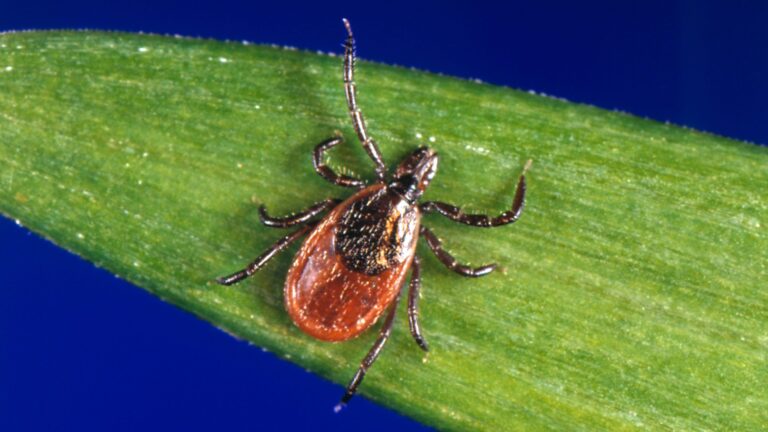
CHAMPAIGN — Tick-borne diseases have been on the rise in Illinois for many years. And new research from the University of Illinois Urbana-Champaign finds ticks are migrating to different parts of the state.
A new study led by Becky Smith, an associate professor of entomology at the U of I, examined three different species of ticks in Illinois and found the black legged tick, the lone star tick and the American dog tick have been moving to different regions of the state when they used to be more consolidated.
“It used to be that you would only find lone star ticks down in the Shawnee National Forest. I have colleagues up in Chicago who are finding them in the Chicago area,” she explained. “You would only find the black legged tick up in the Chicago area, up along the Wisconsin border, and now we’re finding them in the Shawnee National Forest. So they’re moving across the state.”
Ticks can migrate by latching onto birds and deer, Smith said. Being able to track where each species is will allow for a better understanding of the risk zones of specific tick borne illnesses.
“We can provide guidance in this particular month in this particular count: You are at moderate or high risk of this particular disease. So that’s the hope, the eventual goal,” she said.
New efforts to increase tick surveillance in Illinois

In August, Illinois passed the TICK Act, which aims to increase tick-borne illness surveillance surveillance across the state.
One of the illnesses highlighted in the new act is Alpha-gal Syndrome, or AGS, which creates a serious, potentially life-threatening allergy to mammalian meat following a tick bite. The CDC has identified Illinois as a state with one of the highest rates of AGS.
Brian Allan, an entomology professor at the U of I, said not a lot of research has been done on AGS, which is why he is particularly excited about the passage of the TICK Act.
“The focus on AGS or Alpha-gal syndrome is something for which we really lack much data at this point,” he said. “This really puts the state of Illinois in the position of being one of the leading entities in the country for collecting data on Alpha-gal syndrome.”
What separates AGS from other tick-borne illnesses is that it’s not a bacterial disease, whicch Allan said makes it harder to understand and treat.
With bacterial infections, “a tick bites you, it transmits this bacterium from the tick to the human, and that bacterium makes you sick, so that’s a really classic sort of case,” he said. “Alpha-gal is not caused by an infectious agent. Alpha-gal is an allergic reaction to a molecule in tick saliva, and so it is just an unusual thing to begin with.”
The most common bacterial infection from ticks is Lyme disease. If not treated early, Allan said the disease can become difficult to treat. It can also be misdiagnosed for other illnesses, which makes it harder to catch.
“If you don’t treat Lyme disease effectively with antibiotics during that acute phase, then some number of patients will develop a chronic illness,” he said. “That’s a large number of people, and so then they experience a lifetime illness that can be quite debilitating.”
How to protect yourself – and your pets – from ticks
When it comes to staying safe from ticks, both Allan and Smith advise people to wear long pants when spending a long time outdoors and use tick repellant.
Checking for ticks after spending time outdoors is one of the most effective ways to prevent tick-borne illnesses.
“Tick checks are really the best thing that you can do, because it takes time for the tick to bite after they’ve crawled onto you, and then even after they bite, it often takes 24 to 48 hours to transmit the pathogen, so you have time to actually find the tick and remove it,” Smith said.
Ticks can also transmit diseases to animals, such as dogs, cats and horses, so tick repellant on animals is another important aspect of prevention.
“It’s really an issue that affects human, animal and environmental health. So we’d like to tackle it as a holistic thing and not just as human health,” Smith said.