

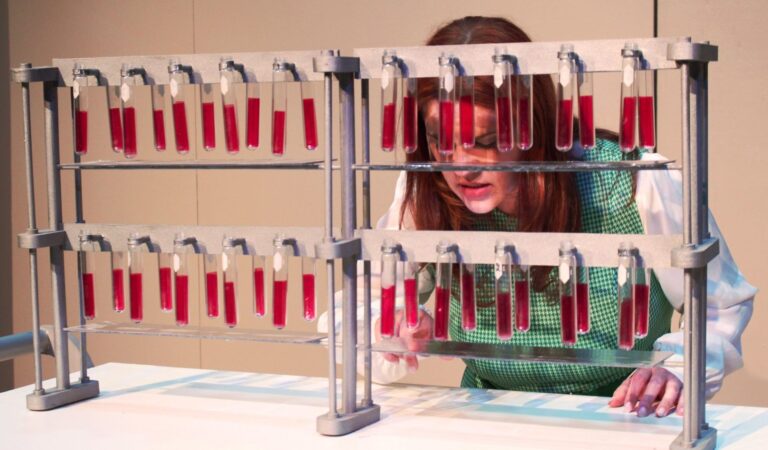
On an ordinary day in 1967, 26-year-old Meg Crane looked at a row of test tubes in her New Jersey pharmaceutical company and had a thought that would quietly revolutionize women’s lives.
“I saw, hanging on the wall, some test tubes, then asked somebody what they were,” Crane said. “They said, ‘Well, those are pregnancy tests…’ Something happened in my brain about it, [and I thought] that women should be able to do this right away, and do it herself.”
Nearly six decades later, her story has its Illinois premiere at Station Theatre in Urbana, showing through Sept. 21. The play, “Predictor,” is also set to premiere off Broadway in New York in December.
Crane’s role as inventor remained largely invisible until 2016, when The New York Times published a story about pregnancy tests that failed to mention her contribution. Crane reached out and the story was rewritten — and subsequently caught the attention of Jen Blackmer.
Blackmer is playwright, screenwriter and theatre professor at Ball State University. She recalled discovering Crane’s story.
“I will never forget this moment — I was sitting on my back porch, it was a beautiful day, I was listening to windchimes, my dog was there and I was just reading the news,” Blackmer said. “I read this article and I was pulled over, and I’ve really kind of started to see how this story could be told theatrically.”
Blackmer’s long-time friend and producer Brian Nitzkin then helped her connect with Crane. From there, the two shared what Blackmer called “marathon phone calls” and email threads as she shaped Crane’s life into a play.
“Predictor” explores Meg’s character’s mind, jumping from past to present to future and, through a gameshow, flashbacks to her childhood and her time working at Organon Pharmaceuticals. The production features Meg’s character and six other cast members.
At the end of the play, rather than giving Meg’s character a monologue, female ensemble members are left on stage to summarize the moment when Meg’s character gets hit with the reality that nobody recognizes she created this product.
Blackmer said she chose to represent that moment as such to symbolize the broader erasure of women in science.
“There have been amazing women like Meg doing amazing things, and when the history of those moments gets written, women are always left out,” Blackmer said. “It becomes that larger sense of claiming our own space in this place of discovery and history. There’s a little bit of Meg in all of us.”
When Roe v. Wade was overturned in 2022, the themes of reproductive justice and women’s autonomy in “Predictor” took on a different significance.
“The joy of having this story being told in play form is that the world is always changing,” Blackmer said. “History is constantly evolving and moving and as much as we like to say we are learning from the past, oftentimes the past comes back in new and unexpected ways.”
And in today’s context, Crane still sees her story as relevant.
“Whatever’s happening in Texas, for instance — women really have to know immediately as soon as possible what their status is for pregnancy,” Crane said. “And I think too that the overall governmental quashing of women and their reproductive rights… it’s going to be worse as time goes on, I’m afraid.”
“Predictor” premiered in 2023 with its first three shows in Nebraska, Indiana and California. Its showing at Station Theatre is its eighth production, which Crane will be attending on Saturday. She has seen a handful of “Predictor” productions and said seeing her story represented on a stage is exciting and interesting.
“It’s wonderful to see each group of actors [doing] a little bit of a different take on it,” Crane said. “I must say — what Jen has done with this is to make it fun and fast moving and it’s really delightful in that sense.”
Crane said she enjoys the audience discussion that always follows the production.
“It’s been fun to hear their stories about taking the test back in the ‘60s, if it’s an older person, and there were a couple of times, sometimes, when young women have taken their mothers and just to get the perspective on what was happening in their mother’s time — it’s wonderful,” Crane said. “It really could go on forever.”
Blackmer echoed a similar sentiment. After overhearing an off-the-cuff conversation between a daughter, mother and grandmother after the show about times when women couldn’t have credit cards or when they were expected to be married, she said it was a reminder of what society takes for granted.
“I want people to take away this connection among generations. I think of the fact that women have, in fact, been fighting for recognition and equality for a very long time,” Blackmer said.
“What’s interesting is that some of the the funniest moments of the play are actually some of the most honest moments to the play, when people are getting angry about things they can or can’t do, and it just seems rather ridiculous and then you find out that there was a whole lot of truth to that.”
Both Blackmer and Crane want audiences to know that this is more than just a play about Crane’s story.
“The most important thing about this play is hope that we end in a place where — when we tell these stories, when we take ownership of our stories, and when we share our stories and our struggles — then we can come to that human connection that is what allows us to grow together,” Blackmer said. “And I think we’re lacking that today in so many different places.”