

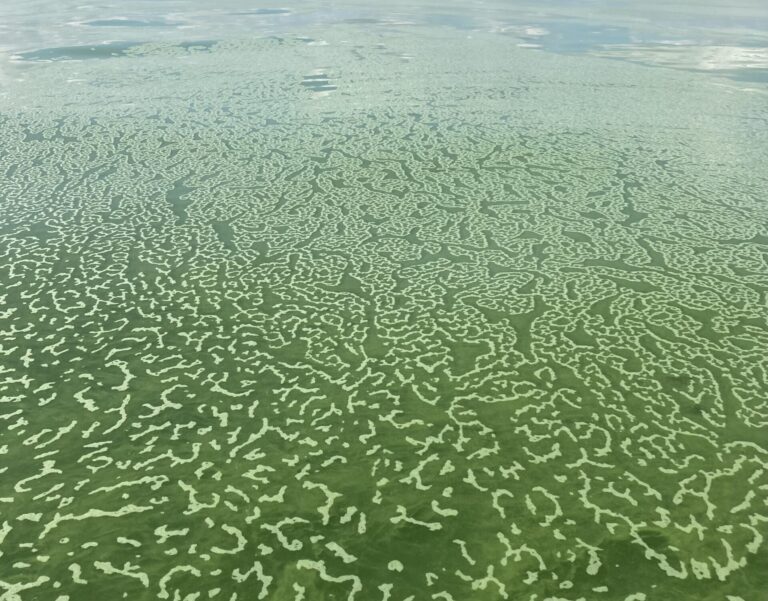
MATTOON– At the height of summer in mid-July, residents of Mattoon in central Illinois were told they couldn’t use their tap water.
Harmful algal blooms had overwhelmed the municipal water system in the town of nearly 17,000, sending toxins into the water supply and making it too hazardous to drink or cook with.
The Do Not Drink order — which stayed in place for about five days —forced restaurants to close or bring in water. Since toxins can’t be boiled away, it created an extra level of concern and confusion among residents, according to Mattoon Public Works Director Dave Clark.
“A lot of them were like, can I wash my hair? Can I take a shower? Can I take a bath?” he said. “And we did put out information about that, but I think even then, they’re like, okay, but can I
really do it?”
The U.S. Environmental Protection Agency says tainted water in lakes can cause skin rashes, but tainted tap water may not, as long as the toxins are below a certain level.
Meanwhile, Mattoon’s algal bloom outbreak coincided with Bagelfest, the town’s 40th annual festival celebrating a local commercial bakery. Now owned by BIMBO, the bakery produces Lender’s and Thomas Bagels and has long ties to the community.
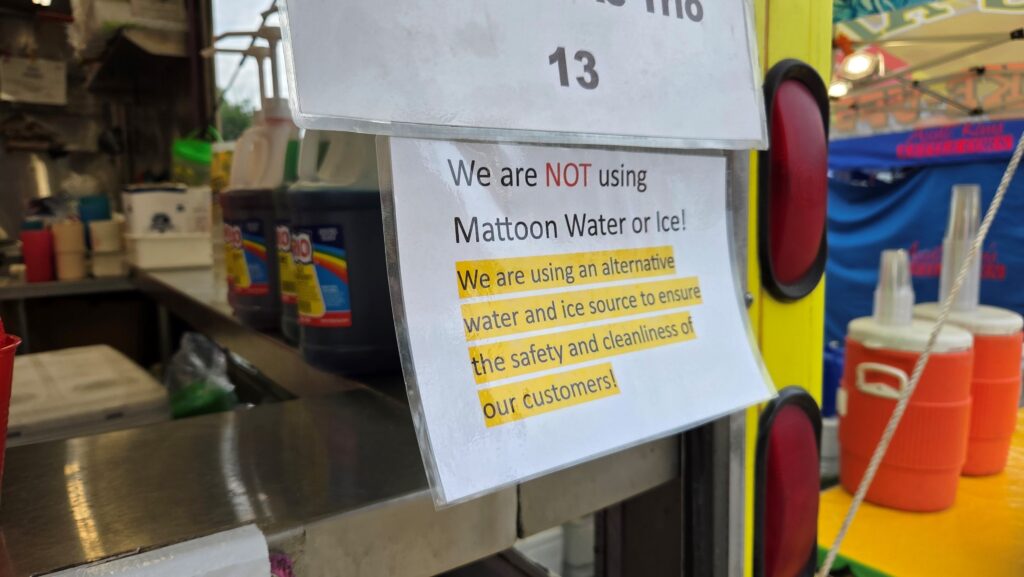
While the live music, carnival rides and even food trucks carried on – water for the festival had to be brought in by truck from out of town. Food truck vendor Chris Walden, who sold lemon shake-ups and funnel cake at Bagelfest, picked up water in a nearby town.
He said the Do Not Drink order affected his home and business, both of which are in Mattoon. “So it’s not just our stand, but it’s also our shop, where we store everything,” he explained. “And then also, you know, our house too, as far as showering and water and everything.”

Harmful Algal Blooms
The bacteria within blue-green algae can create dangerous levels of microcystins, or neurotoxins, which can sicken and even kill people who drink, cook or wash with water containing them.
Repeated exposure can cause gastrointestinal symptoms such as vomiting and diarrhea, as well as damage to the liver, brain and other organs.
Yet reports of illness from people ingesting tap water tainted by algal bloom toxins seem to be rare. University of Michigan Professor Gregory Dick’s research focuses on microorganisms and water quality. He said there are well-documented reports of people getting sick from swimming in lakes with algal bloom toxins.
“That is a relatively common occurrence,” he said. “So the health threats are real and the other thing that we know is that pets, and especially dogs, are particularly vulnerable to these harmful algal blooms. In fact, every year, dogs die from swimming in this water.”
Bacteria and algae are always present in lake and river water. But they become a health hazard when they multiply into algal blooms, large colonies fed by nutrients like nitrogen and phosphorus used to fertilize crops, and animal waste from large livestock operations or sewers.
Robert Hirschfeld, director of water policy with the Illinois-based environmental group Prairie Rivers Network, said more and more farm chemicals have run off into lakes and streams over the years.

“I wouldn’t say that there were no harmful algal blooms a hundred years ago,” he said. “But as we track them, the frequency and severity has increased in recent years.”
Hirschfeld’s organization supports laws that would require the farming sector to take a more active role in preventing erosion that spreads fertilizer chemicals into rivers and lakes.
“We think it’s long past time that we treat agriculture as the big boy industry that it is,” he said. “It’s a major, major industry in this country, and we need to pass laws and rules that require (them) to reduce their pollution.”
A sizable algal bloom can make a lake unsafe for swimming or boating. But a bloom can also infect a public water supply.
Algal blooms in other water systems
Mattoon is hardly the only city that’s dealt with the problem. In 2023, an algal bloom in one of the reservoirs for Guthrie, Oklahoma forced the city to quickly switch to another of its water sources.
A massive algal bloom in Lake Erie prompted a three-day Do Not Drink advisory for more than 400,000 people served by Toledo Ohio’s water system in 2014. A few weeks later, the same algal bloom led to warnings not to use water from private wells on the shoreline of Pelee Island in Ontario, Canada, Lake Erie’s largest island.
The impact to residents when a toxic algal bloom affects their water supply is substantial, according to Dick.
“That affects not just people’s drinking water, but their ability to take medicines, their ability to shower, their ability to cook,” he said. “So it really disrupted lives for residents, for businesses, for hospitals.”
After that crisis, Toledo installed expensive sensors and carbon filtration to help make sure its water supply is clean. Such solutions will likely be needed in more towns and cities throughout the Midwest, Dick said, as algal blooms don’t appear to be slowing down.
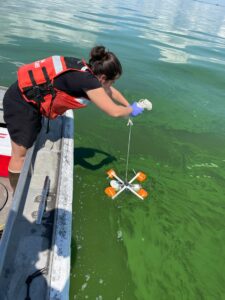
Yet Keith Loftin, who studies algal blooms at the U.S. Geological Survey’s Kansas Water Science Center in Lawrence, said it’s difficult to know if the blooms have actually gotten worse.
“Many claim that blooms are becoming more frequent, greater in magnitude, duration and spatial extent,” he said. “However, largely, we lack robust, consistently collected data sets throughout modern times to make large sweeping national and global statements.”
University of Wisconsin Environmental Sciences Professor Todd Miller studies water-borne toxins and the microbial life that produces them.
He said the conditions to create harmful algal blooms are on the increase, even if the data is lacking to be sure harmful algal blooms are on the rise.
“We’re at the point now where around 70% of all water bodies in the United States are nutrient rich, or what we call eutrophic,” Miller explained. “So in that sense, we are seeing an increase across the nation in the number of water bodies that can support the formation of algal blooms.”
Mattoon prepares for more algal blooms
A couple of weeks after it lifted its Do Not Drink warning, the Mattoon City Council voted to spend roughly $300,000 on a new water pump to replace a broken one at its Lake Mattoon reservoir and to spray algaecide to control algae blooms in both of its reservoirs.
City Manager Kyle Gill said that eventually, they’ll need to dredge both reservoirs to get rid of fertilizer-embedded silt.

“We’ll spend hundreds of thousands of dollars in the short term, but most of the long-term solutions are millions of dollars,” he said.
Regular testing in August shows neurotoxins to be at safe levels in the city’s water supply.
But after a new algal bloom appeared in Lake Mattoon in August, that reservoir’s beach was closed to the public, and remained closed for much of the month.