

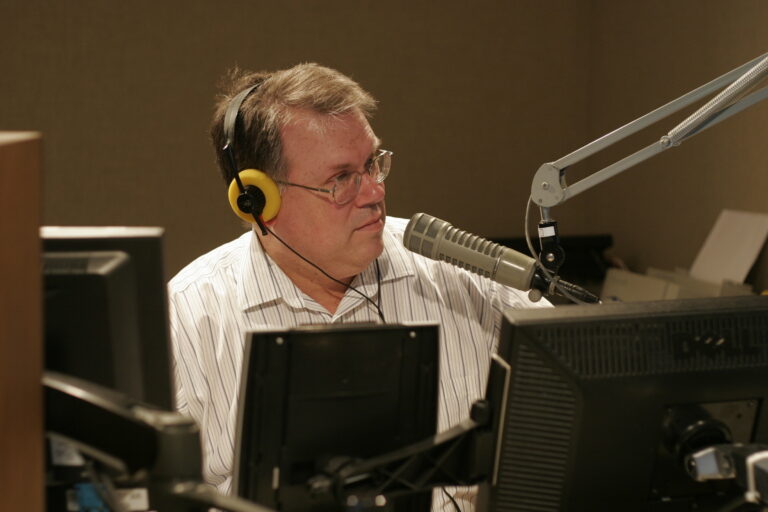
Jim Meadows has been reporting and hosting at Illinois Public Media for over 25 years and is now stepping into retirement. He sat down with Morning Edition host Kimberly Schofield to reflect on his long career and what the future holds.
This interview has been edited for clarity and conciseness.
KIMBERLY SCHOFIELD: Jim, how did you first get into journalism?
JIM MEADOWS: First I got into radio, and then I got into journalism. I was a news anchor first at WCBU, the public radio station in Peoria. At that time, I was half news anchor and half jazz music director for a late night jazz music show they had at the time. The news director then, who was Dave Houghtaling, got me into news, and that’s when I became full time in that part of radio.
SCHOFIELD: Okay, so did you just like radio growing up, or was it something you kind of fell into?
MEADOWS: I liked radio and I found out that I liked public radio so it was a goal early on to work in public radio, even though this was the 1970s and public radio was a lot smaller than it is now. It looked like all the interesting stuff was there.
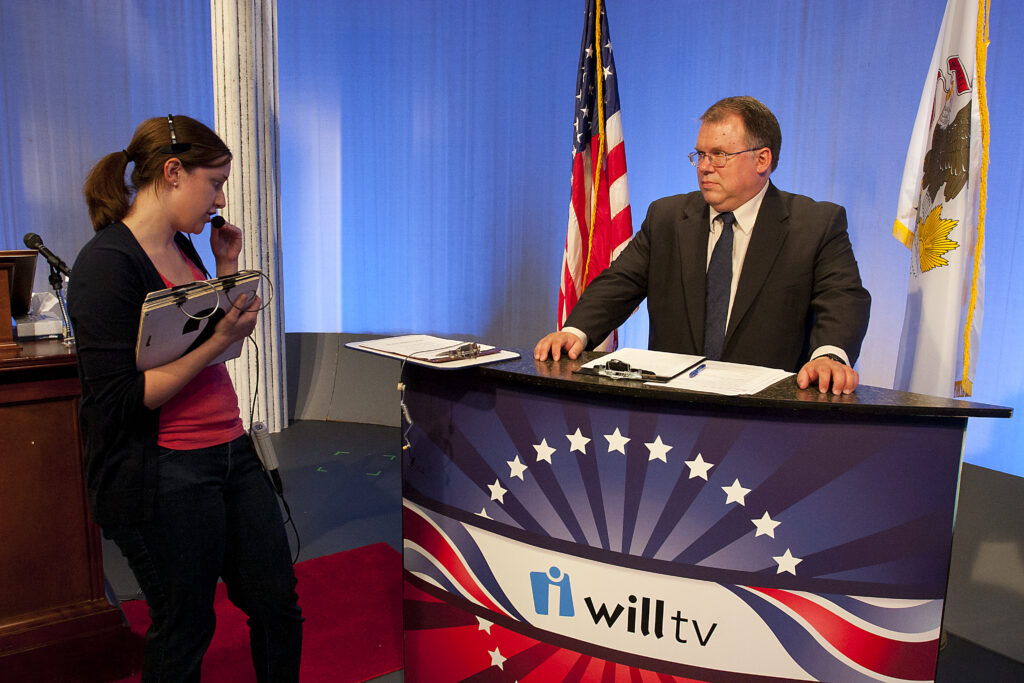
SCHOFIELD: Jim, when you first came on at Illinois Public Media, you were a reporter, correct?
MEADOWS: That’s right.
SCHOFIELD: Were you a general reporter? Did you have a specific beat?
MEADOWS: General reporter. So I just spent a lot of time, you know, making phone calls, going to news conferences. At one point I was sort of like the evening government meeting reporter, and that was my schedule. I would go to city council and school board meetings and anything that met at night.
SCHOFIELD: What is it like comparing your job now -or your responsibilities now- at Illinois Public Media compared to when you first started?
MEADOWS: Well, the medium has changed. When I first came here, I was not thinking about the web. I was not thinking about taking pictures for a radio station, for instance. And I was not thinking about all of the media connection that is outside of linear broadcasting. It was linear broadcasting that was set in my mind when I decided I first wanted to get into the business, but it’s changed. And the fact that at least a lot of people in the business say ‘public media’ instead of ‘public broadcasting,’ tells you how things have changed for people who work at it, and things have changed for audiences.
SCHOFIELD: Is there something specific that you enjoy covering the most? Anything that speaks to you?
MEADOWS: A lot of things that speak to me are in terms of when I see a question that hasn’t been answered, and trying to figure out, ‘well, why is this thing happening?’ A lot of stories that have interested me have also been in connection with history, whether it’s some historical element underlying a news story, or just pieces of history in whatever area I’m in. So for instance, a couple of years ago, I was able to spend a year working on programming for WILL radio’s centennial.

Doing the daily state History Minutes, but also doing features about the history of this radio station. That was a lot of it was a lot of work, but it was a lot of fun, as well. And there were a lot of things to find out about the history of the state and and the history of this station and the history of public broadcasting in general.
SCHOFIELD: Jim, one of our colleagues mentioned a feature that you did. A story on George Rock?
MEADOWS: Oh, George Rock, the trumpeter for the novelty band of the 20th century, Spike Jones and His City Slickers. And he also had a little kid voice that he used on several records for them, including his biggest hit, “All I Want For Christmas Is My Two Front Teeth.” George Rock was from Farmer City, about half an hour’s drive from Champaign-Urbana. He was born there and he is buried there. And one Christmas season, I decided to just look into him. And the interesting thing about the George Rock story is that doors were opened for me. Everybody connected with George Rock, wanted to talk about him.
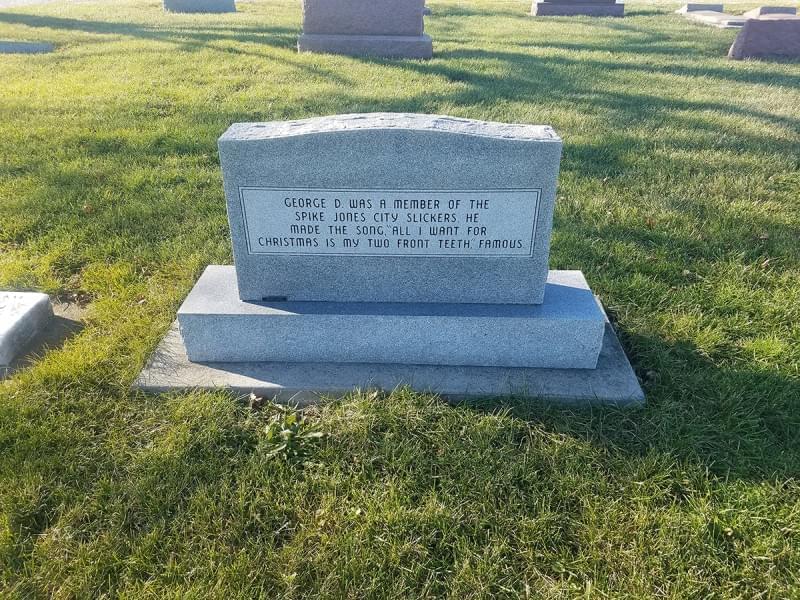
It was a great opportunity to talk with people in Farmer City, people with the local history group, there was someone who knew him in highschool, his daughter, the perhaps last surviving member of Spike Jones and His City Slickers, entertainment historians, the novelty DJ, Dr Demento. I was able to interview him about his knowledge of George Rock and put together a story really highlighting that novelty record, which was a freak surprise hit in the 1940s, but also really his own very solid musicianship and what he gave to that particular band.
SCHOFIELD: One that you helped cover was the last appearance of Chief Illiniwek. What was it like, covering something like that?
MEADOWS: That was very intense at the time. The Chief Illiniwek controversy was something that everybody at the WILL newsroom was covering throughout, I would say, the 1990s and the first decade of the 21st Century. There were a lot of stories covering both the supporters and the opponents of Chief Illiniwek who were both very vocal with very strong opinions. But that particular day, which was billed as the last appearance by Chief Illiniwek, after the President of the Board of Trustees at the university ordered the end of the use of the symbol officially, that brought out a lot of people to that particular basketball game. And the depth of feeling among the audience with the person performing Chief Illiniwek, at the time, was very strong that night.
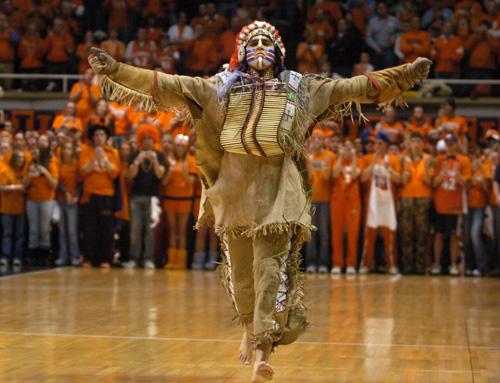
At one point, there was a moment where everybody in the stands came out onto the floor essentially to celebrate Chief Illiniwek for one last time. It was just a strong wave of emotion among these supporters of the Chief, and an interesting contrast to the strong wave of emotion that you might feel at an event featuring opponents of Chief Illiniwek, who also made their voices heard over the years.
SCHOFIELD: Circling back to your nighttime meetings, which oftentimes are City Council meetings, members approved the use of tasers by the police department at a Champaign City Council meeting, at this point, a decade ago, 10 years ago.
MEADOWS: That’s right. And that, I think, is, you know, just a point in a long history in Champaign-Urbana, which I’m sure played out in many other cities across the country, about race relations in a community, relations between police and the Black community, in any particular city. In this case, it was the city of Champaign, but it could have been a whole number of other cities.
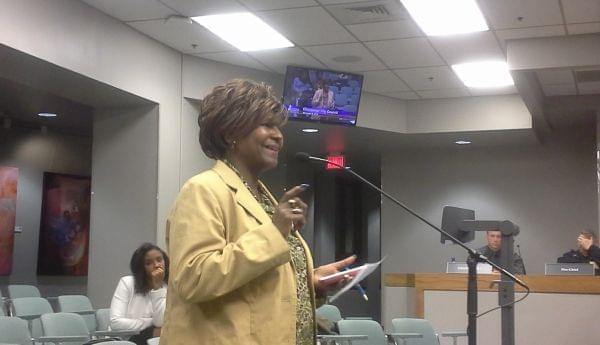
And I remember covering that because there were strong opinions on both sides of whether tasers were a good idea. Some people saw them as a way to reduce violence in police-community encounters, other people saw that tasers brought their own risks and dangers, and that it could actually increase violence because police might feel ready to use them with the belief that they were not dangerous.
SCHOFIELD: What do you like about radio as a medium, compared to other sources?
MEADOWS: It’s right there. People talk about radio as being an intimate medium. I was one of those kids who had the transistor radio, listening in bed with the radio under my pillow to a top 40 station, back in the days of very ‘out there’ involved DJs. That was a sort of broadcasting that brought me in, originally. That’s not what I ended up doing, but there’s something in all of that, a certain amount of involvement and spontaneity, I guess, that’s always appealed to me.
SCHOFIELD: Jim, I asked you this two weeks ago, maybe? You do not have to have an answer, but some of our colleagues and, of course, myself, and I bet our listeners are wondering, what is next for you?
MEADOWS: I don’t know.
SCHOFIELD: That’s a good answer.
MEADOWS: I’m going to find out. It’s really been a privilege for me to be able to work in broadcasting and public broadcasting all these years. This is what I wanted to be when I grew up, and I got to do it, and it’s been intensely rewarding. I’m not rich, but it’s been rewarding in a lot of other ways.