

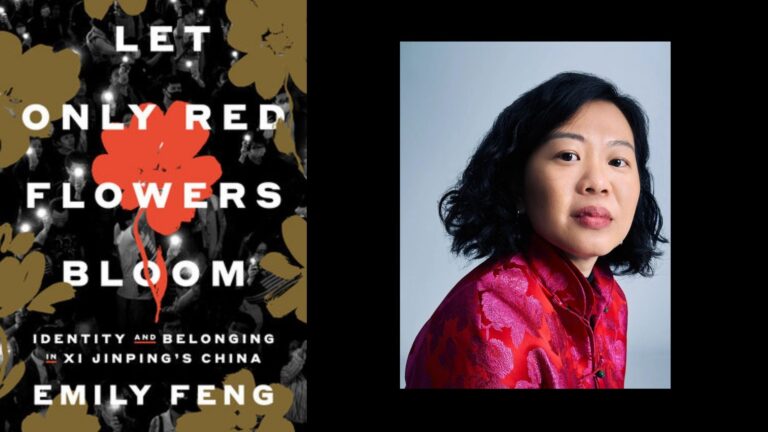
For years, NPR’S Emily Feng traveled all over China, bringing intimate and informative stories about the nation of 1.4 billion people, but in 2022, the country’s government said she could not report from there anymore.
This year, Emily published a new book called “Let Only Red Flowers Bloom.” It explores life under the rule of Chinese President Xi Jinping. IPM News’ Reginald Hardwick spoke with Emily. She started off by sharing the inspiration for the book’s title.
EMILY FENG: In the 1950’s there was tightening of control under the then ruling Communist Party. They’d just been in power for a couple of years, and Chairman Mao -Mao Zedong at the time, said, let 100 Flowers bloom, let 100 schools of thought contend. And it was supposed to be…it was suddenly that this idea that you could start expressing yourself again. And he said he wanted to hear dissenting ideas even. But then he changed his mind pretty quickly afterwards and arrested a bunch of people. And people now look back at that period of time as kind of a trap. But this phrase was then repeated back to me with a slight modification, like only red flowers bloom. Red being the color of the Communist Party. A couple of years ago when I first started reporting for this book, and it was said to me by someone who had been very active in the publishing world, in the Muslim religious community in China as well. And he said to me, you know, in the past, the communist party wanted all flowers to bloom. There had been a few decades of relative political openness. Now that space is closing again and the state will only let red flowers bloom and that was the working title of my book. As I was writing it, I thought about changing it, but I kept it because I felt like it encapsulated the ethos of the book well.
REGINALD HARWICK: Your chapters, the lawyer, the businessman, the scooter thief and so forth. Talk about how various people deal with the increasing rule of law under Xi Jinping. Why did you lay it out like that?
FENG: I wanted to tell stories of people, much like I do in NPR stories and audio stories, but to take these big societal shifts and policies that very much matter, they’re in the headlines, but then base them in how they affect people’s lived experiences on the ground in not just China, but also Taiwan- in the US. You know, I profiled the Chinese diaspora in North America and how it’s changing the course of their lives. And many of these people are not who we would consider dissidents. They’re not famous people. They’re ordinary folks who most of them season, see themselves as Chinese in some way, as patriots, and then all of a sign sudden, find themselves on the outside and disenfranchised because of narrowing restrictions on what the Chinese state wants its citizens to think and behave. And so I also tried to get into the story in colorful ways. So, you know, I profile someone who goes viral for stealing scooters and then encounters firsthand the pervasive censorship online, on the Chinese internet-someone who is found chained in the middle of winter in a in a shed, and provokes this nationwide soul searching about what is the role of women in Chinese society, a woman who starts out as a state prosecutor and becomes very, very famous for asking for leniency in a murder case, but then decides to switch sides and become a human rights lawyer that sues the government and how she makes that transition and why she believes that China should develop in a different way than how it’s currently developed. So going through people’s really personal experiences to tell bigger stories about the China that we hear about all the time in the news and on NPR, you know, as a political competitor, as an economic superpower, but grounding it in people’s very personal experiences.
HARDWICK: For people who are used to the free press here in America, what is it like to report there? I was also struck by the fact that at one point you were blocked from entering the country.
FENG: China is so big and it’s so organically diverse. I wanted to highlight that in the book. It’s not a monolith. So there are more and more restrictions on especially Chinese reporters, but also foreign reporters like myself. But when I was there, there was still as long as we were willing to push the envelope a little bit and be on the road all the time, there was still so much that you could get people who are still willing to talk despite the dangers, and that’s still true today. But when I was there, I think one of the big developments was there’s always had been in person surveillance and interference in reporting. But if you got the information, you managed to convince people to talk to you. We would get it out there, we’d publish, we’d put it on air. There are no restrictions, of course, on NPR, as an American company, with what we have to publish. We don’t comply with Chinese censorship orders. But when I was in China, the digital surveillance tools became so much more mainstream, and especially when the COVID pandemic hit and a lot of foreigners and a lot of reporters either left or were unable to come back into China, there were just fewer people to surveil. And so that meant that you had a growing security state, essentially more police in China because their budget was increasing and fewer targets to surveil. And so the digital surveillance of people we talked to, our travel, our reporting plans, the people that we hired and worked with -my on the ground, movements just became so much more closely tracked. And in the past, where you might have, say, you know, a day or two before local authorities might find out that you were on the road and traveling to a place and meeting a person, we would have one or two hours in the last couple of years, because they’d just be able to find us so easily.
HARDWICK: What do you want most for people to understand about this book and the people that you’ve profiled in it?
FENG: The story of China is increasingly global, So there’s a reason why this story, this book, is about people who some of whom are based in China, but also some of whom are going through these struggles and trying to create a Chinese identity, and engaging with these ideas of Chinese influence outside the borders of the People’s Republic of China, because the influence of China is global, and this conversation between the US and China is affecting third party countries and regions that are not even in the Asia Pacific. So these themes of identity and their implications for people outside of China are more and more pressing. But the second thing is, I hope that people can read these stories, even if they don’t follow news about China, and understand that there are, you know, there’s 1.3 billion people in China. They don’t all think the same way. In fact, they behave and speak different languages and come from very, very different walks of life and backgrounds, and that they’re not all the same. And then I hope that they find resonance and meaning and beauty and tragedy in these stories in the book, which I try to write in kind of a more novelistic way, despite the fact that they’re in China, that they might find parallels with their own lives, simply because every one of the story is a human, a human being.
HARDWICK: Emily Feng with NPR, author of the new book, “Let only red flowers bloom”. Thank you so much for talking with me today.
FENG: Thanks Reginald.