


DANVILLE — At first glance, the open green near the Danville Correctional Center looks like a city plaza. There are sidewalks, large stretches of grass, a fire hydrant and a patch of lilies.
It’s only when visitors turn around the corner that they see the coils of barbed wire on the tops of the center’s buildings.
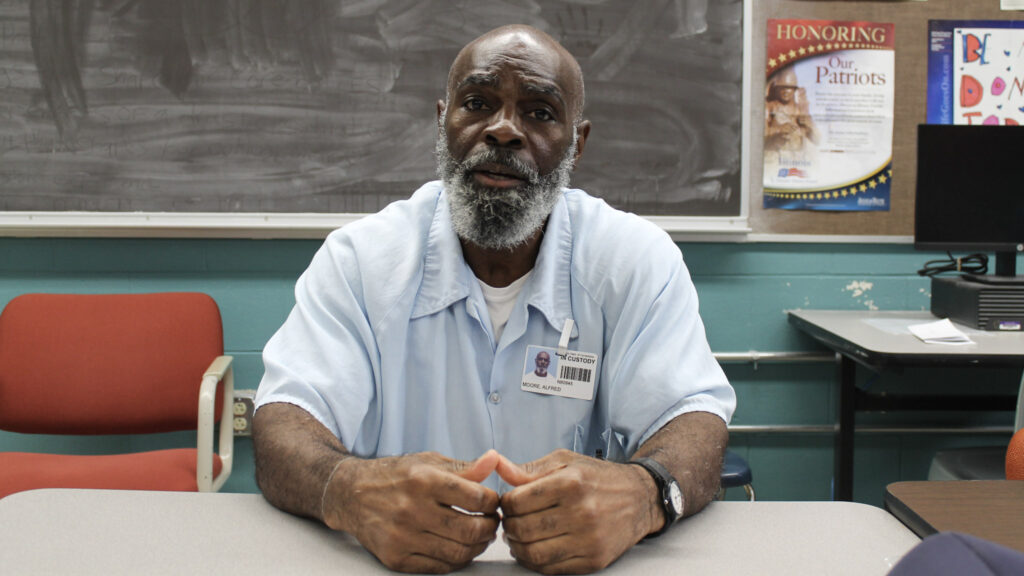
When Illinois closed the century-old Stateville Correctional Center last year because of dangerous conditions, Alfred Moore-Bey was one of the over 400 men incarcerated there who prison officials dispersed across the state. He was first sent to another maximum security prison and then applied to move to Danville’s medium security environment.
“Being in a close environment where you socialize a lot, where there is a lot of movement happening, that’s different,” Moore-Bey said. “People are leery of that after being on the max level for so many years.”
That transition from max to medium can be overwhelming. The noise, energy and relative freedom of movement is overstimulating for those who have trained themselves to be on high-alert in rows of quiet cells, like Moore-Bey has.
“A lot of people when they’re making their transition seem to be stand-offish and don’t want to say much,” he said.
Danville was one of the first prisons in the state to facilitate those in prison teaching peers with the Building Block program in 2018. Similar programs have sprung up in other wings of Danville (and in other prisons across the state).
The latest course, the Long-Term Transitional Program, is for those adapting from maximum security environments elsewhere into Danville’s long-term offender wing. The program officially began in November 2023, according to Illinois Department of Corrections spokesperson Naomi Puzzello.
The idea came from an incarcerated man named Xavier Anderson, who received approval from Danville administrators and recruited peers to create the curriculum and teach it. Michael Abdur Rauf Hearn, who has been incarcerated for 23 years for murder, was among those who helped create the curriculum.
“We’ve kind of piecemealed it,” he said.
Adapting what worked for Building Block, Hearn helped put together a three-month program with units on critical thinking, communication, trauma and life planning.
Hearn met Alfred Moore-Bey when he moved into the long-term section of the prison.
That’s when he found out that Moore-Bey had already taken higher education courses on restorative justice at Stateville. So, he asked him to help out.
Moore-Bey, who is sentenced to life in prison for abetting a murder, teaches three communication skills classes a week, plus weekends and tutoring.
His style is about asking questions of those he is teaching – like what their pet peeves are and whether they stay silent or speak up when those situations come up.
“When you can start to see the wall come down and now people become more who they are and not what they have become over the years,” Moore-Bey said.
Hearn said they are wrapping up the last module of the curriculum, and he can tell that students are learning.
“I like it when, whether it be on the yard or whether it be in obscure places like the commissary, I hear somebody repeating to another person something that they learned,” he added. “Because then it means they’ve internalized it.”

Corrections counselor Jason Baer oversees the program from the staff side. He says Moore-Bey, Hearn and the others do the heavy lifting, and in a short amount of time they’ve already helped the younger and older men get to know one another.
“The speed of the younger guys, it’s almost an overstimulation. They can be very grumpy about it,” Baer said. “Those guys [teaching the course] are awesome and are like, ‘Go meet them. See how they got the pep in their step.’”
In the process of teaching others, Moore-Bey has learned more about himself.
“I didn’t think I was an effective communicator. Going through the program, it showed me that actually I’m pretty good at it and it’s natural,” he said.
While this summer’s classes are wrapping up, the course will continue in August with new students.
Updated 4 p.m. July 24, 2025 with more information from the Illinois Department of Corrections.