

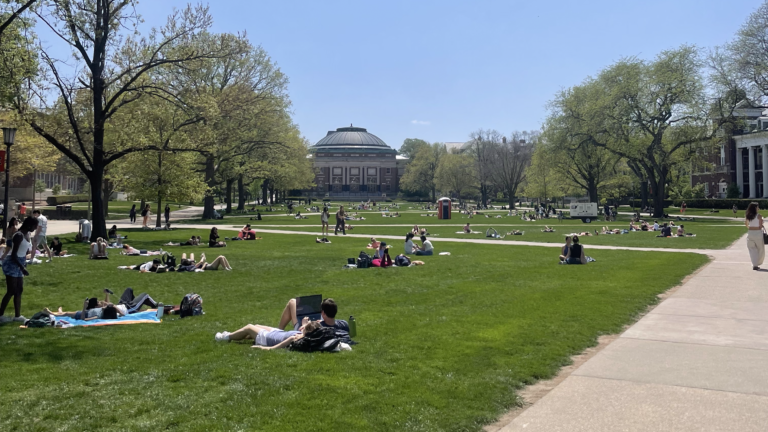
URBANA — Climate change is leading to hotter summers nationwide, and Illinois is no exception.
Global temperatures have risen about two degrees Fahrenheit over the past century — as a result of fossil fuels emitting carbon dioxide into the atmosphere.
Summer officially kicks off Friday, June 20, and with it, will come higher temperatures and humidity, which can be hazardous to both human health and agricultural ecosystems, said Trent Ford, Illinois’ State Climatologist, who studies extreme climate and its impact on the Midwest.
“Summertime in Illinois, not only do we have, especially early summer, moist soils, abundant water, usually, we also have the Gulf of Mexico a few hundred miles south of us, that is happy to provide us with lots of moisture,” Ford said.
Warmer air can hold a lot more water. And in the Midwest, agriculture can contribute to elevated humidity as well.
“Here in Central Illinois… corn actually can raise humidity by a little bit as it grows and matures here in the next couple of months,” he said. “There’s a lot of water in those corn plants and in those corn stalks and the leaves.”
Humidity coupled with higher temperatures can exacerbate heat-related health issues. When humans sweat, the sweat evaporates, effectively cooling the human body. But with high humidity, the sweat evaporates at a slower rate.
“And so what that means is that if you are at the same temperature, let’s say, the air temperature at 95 degrees, but you have higher humidity, your body is less able to cool itself,” Ford said.
Humidity can also contribute to more severe weather events, like thunderstorms, said Jeff Frame, a teaching associate professor in the department of climate, meteorology, and atmospheric sciences at the University of Illinois Urbana-Champaign.
“Warm, moist air is fuel for thunderstorms,” Frame said. “And so during the summer, the weather’s temperatures are a lot warmer than they are during the winter, and so that allows the temperature to decrease pretty rapidly with height in the atmosphere, and that’s another ingredient we need for a thunderstorm.”
In the coming weeks, Frame said temperatures will rise, with July expected to be the hottest month of the year. He recommends limiting outdoor times during the hottest part of the day, between10 a.m. and 4 p.m.
Reducing carbon dioxide emissions is crucial to mitigating the climate crisis. Ford said people can take part in climate solutions by walking, biking and using public transportation.
“Champaign-Urbana, in general, we have one of the best bus systems of any small city in the region,” Ford said. “And it is a bike-friendly city.”
Supporting local agriculture and food production also helps to reduce carbon dioxide emissions.
Frame also encourages people to look to solar, wind and geothermal sources of energy.