

Preserving history, improving imagery and correcting historic wrongs are focus of Statehouse advocacy
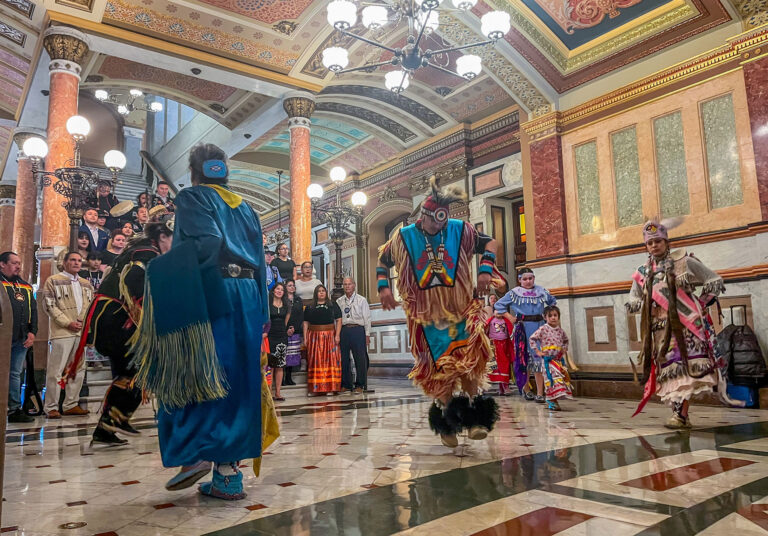
SPRINGFIELD — Amid the annual bustle at the Illinois Capitol during the legislative session’s midpoint, a sea of color and singing filled the rotunda on a sunny March day.
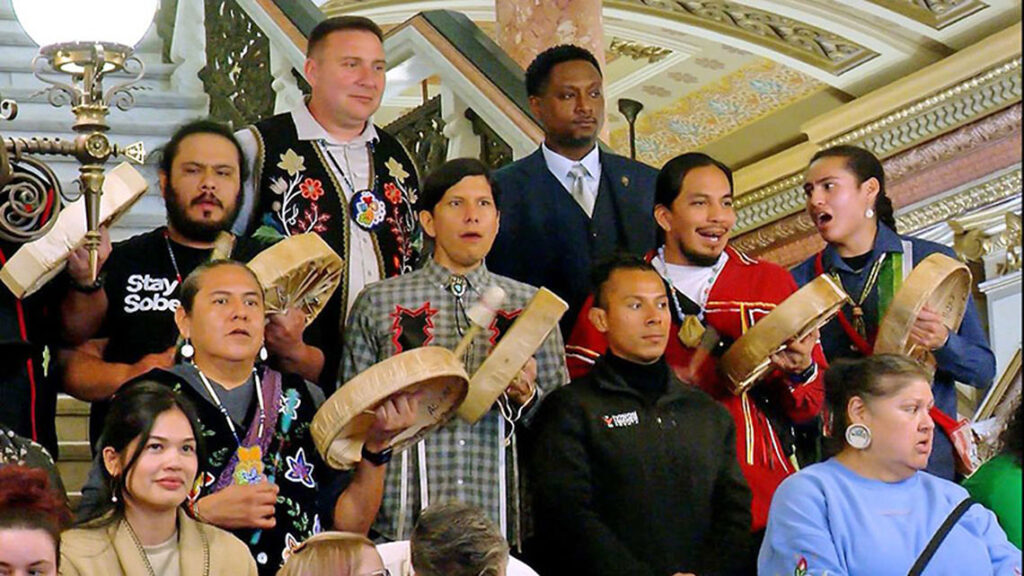
Attendees of the 2025 Native American Summit, organized by the Chicago American Indian Community Collaborative, were draped in regalia and leading a drum ceremony for the first time in an Illinois that was home to a federally recognized tribe.
And it was happening amid a backdrop of Native American groups working to secure passage of a bill that would ban what they say is offensive imagery in Illinois school mascots.
“Our identity has been frozen in time, and it’s going to stay frozen in time as long as we’re portrayed as mascots and things of the past,” said Matt Beaudet, a citizen of the Montauk Tribe of Indians who was in Springfield to advocate for the bill’s passage.
Andrew Johnson, a citizen of the Cherokee Nation and executive director of the Native American Chamber of Commerce of Illinois, explained the importance of attire.
“We will refer to the clothes that we wear – the traditional clothes that we wear – as regalia. It is something that is honored. It has been passed down,” Johnson said. “There are reasons for wearing the particular items that are there. So, we have that term, ‘regalia.’ It’s built and has the bedrock of respect and honor.”
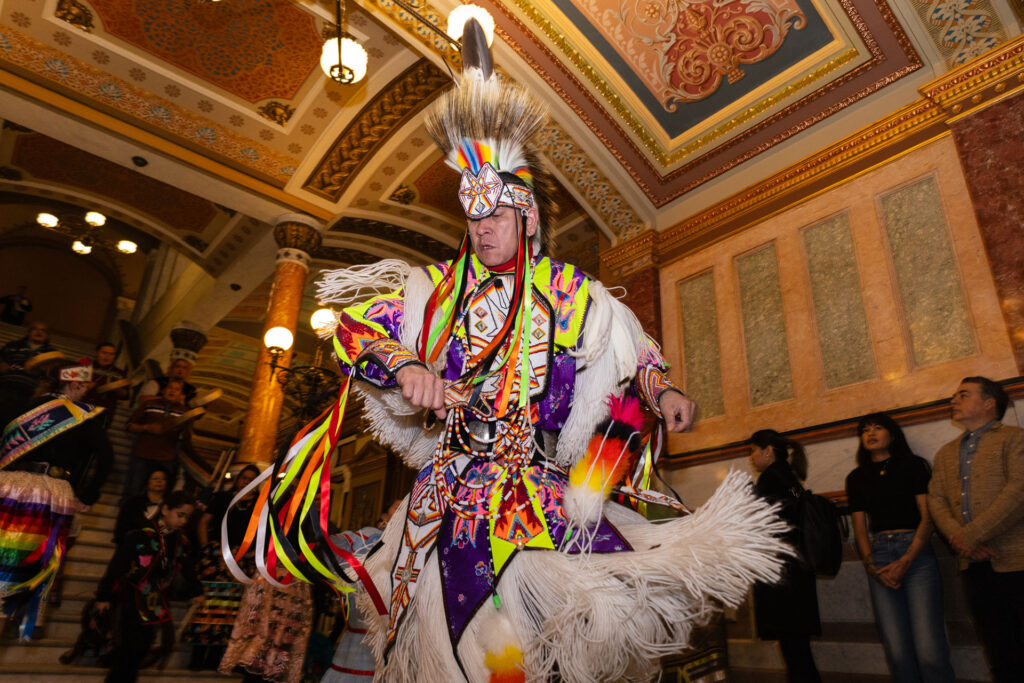
How natives are often portrayed as mascots in school logos throughout the state, however, has a more detrimental effect of “costuming,” he said.
“It really is not a sense of honor there,” he said. “It is not a sense of history. In fact, it’s a perversion of history to think that these mascots are maintaining any kind of that memory of Native people.”
Johnson and Beaudet are part of a working group convened by state Rep. Maurice West, D-Rockford, that’s at the forefront on Native American issues at the Capitol.
In the past several years, Native American advocacy groups have scored what they call major victories in state government.
The state has agreed to return tribal land in northern Illinois, required schools to teach Native culture, allowed high school students to wear cultural and religious items during graduation, and streamlined the process of repatriation and reburial of Native American remains and artifacts.
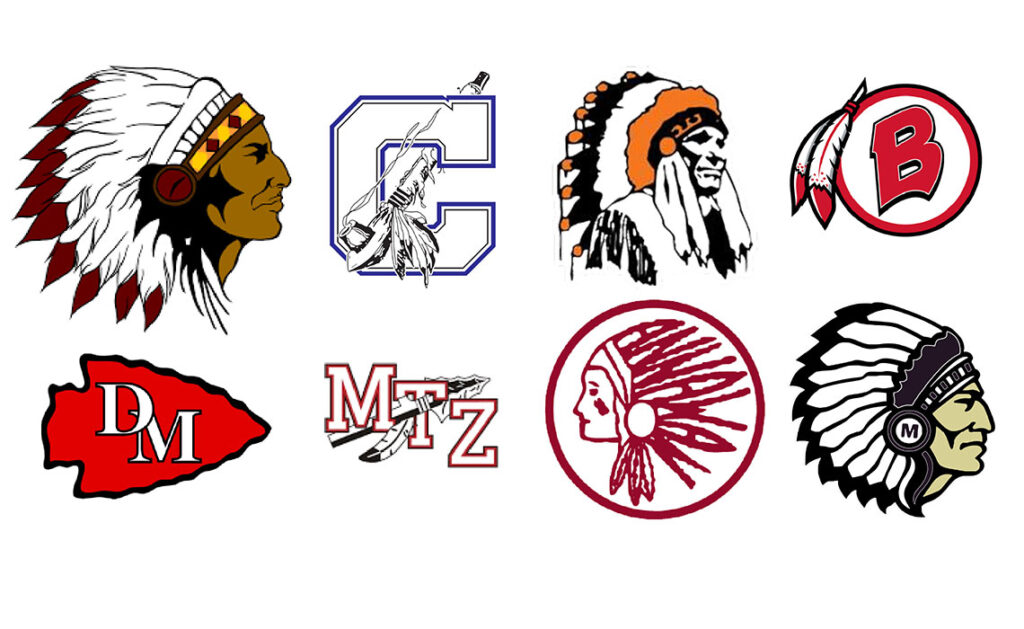
This year’s top priority would require K-12 schools to pick new logos and mascots by July 2026 to replace any that have Native American names and imagery by 2030. That measure passed the House 71-40 on April 10 and is awaiting action in the Senate in the session’s final three weeks.
If it becomes law, it will mark the latest in a series of policy wins for Native groups that have been working at the Capitol for measures they say go a long way toward righting historic wrongs.
The return of stolen land
The most recent bill to earn the governor’s signature returns stolen land to the Prairie Band Potawatomi Nation. Gov. JB Pritzker signed that measure nearly a year after the Prairie Band became the state’s first federally recognized tribe in April 2024.
Illinois has a well-documented history as a removal state, meaning Native Americans were forcibly removed multiple times, including through the Trail of Tears. The Prairie Band Potawatomi’s land in DeKalb County was erroneously declared “abandoned” by the U.S. government and sold at auction in 1849 because Chief Shab-eh-nay had temporarily left the land to visit relatives in Kansas.
For decades, the nearly 1,500 acres had been state park land. State Sen. Mark Walker, D-Arlington Heights, helped usher the measure through the legislature before its ultimate passage in January following heated debate and a narrow 63-41 vote in the waning hours of session. Walker also sponsored the measure focusing on repatriation and reburial of Native remains.
“These two issues, the one about a reservation and the one about Indian burials, came to my attention as two really difficult issues to solve,” Walker said. “And they’ve been around the state probably 30-40 years.”
The legislative win for the Prairie Band Potawatomi was years in the making, a product of organized lobbying and coordination. Joseph “Zeke” Rupnick, tribal chairman of the Prairie Band and Shab-eh-nay’s descendant, was a mainstay at the Capitol in the lead-up to the passage of the measure.
“This moment reflects the power of collaboration and the shared desire to build a future rooted in justice and respect,” Rupnick said in a statement following Pritzker’s March signing of the bill. “Illinois has shown true courage and vision by leading the way in the Land Back movement, demonstrating that healing and reconciliation are possible.”
Even with the land transfer measure passed, the Prairie Band’s involvement in state policymaking isn’t going away.
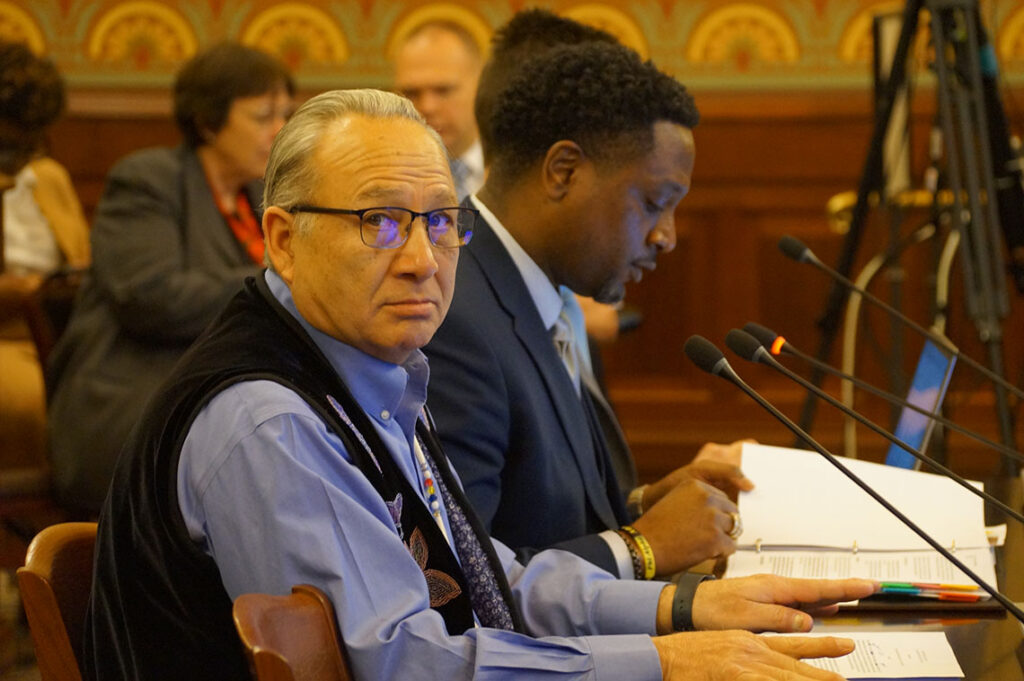
“We, the Prairie Band Potawatomi Nation, being the first tribe to have some of our unceded treaty lands reaffirmed here in the state, have tried to be very involved in issues here within the state,” said Raphael Wahwassuck, a council member for the Prairie Band Potawatomi Nation.
Wahwassuck is also a member of West’s working group and is pushing to secure passage of the mascot ban, among other policy changes.
“I hear counterarguments about how ‘oh we’re honoring’ or ‘this is our tradition,’ and I just don’t empathize with those because there’s better ways you can honor an individual or a group of people,” he said of the portrayal of Native Americans as school mascots.
Advocacy evolution
The mascot ban before the Senate is not a new proposal – even for its House sponsor. West, the Rockford Democrat, first tried to pass legislation in 2020 that would ban Native mascots in K-12 schools, but he changed his plans upon a call from Johnson.
While Johnson relayed to West that mascots are an issue, he and other advocates wanted to prioritize something else: requiring schools to teach Native history.
“The posture I have for my working groups is I’m the chauffer,” West said. “When I meet with them, they tell me what they want to do, and I simply share with them if there’s a path forward, and if there is a path, we start driving.”
That measure, sponsored by West, was signed into law in 2023, with the requirement taking effect this school year.
Les Begay, a working group member, citizen of the Diné Nation and leader of the Indigenous People’s Day Coalition, said in general, Illinoisans don’t know much about Native Americans. That’s why measures such as the Mascot ban and history requirement are so important, the tribal leaders said.
“There’s so many people in Illinois that have been born here that know nothing about Cahokia,” Begay said, referring to a state-managed UNESCO World Heritage site located in St. Clair County.
This article is part of the Healing Illinois 2025 Reporting Project, “Healing Through Narrative Change: Untold Stories,” made possible by a grant from Healing Illinois, an initiative of the Illinois Department of Human Services and the Field Foundation of Illinois that seeks to advance racial healing through storytelling and community collaborations.
After a recent central Illinois case that gained national media attention, prompting almost-daily protests, this project sought to engage diverse rural communities with information that brings neighbors together and moves us forward.
Managed by Press Forward Springfield, this project enlisted three central Illinois media outlets to produce impactful news coverage on the disparities and tensions within and among the region’s diverse communities while maintaining editorial independence.
Capitol News Illinois is a nonprofit, nonpartisan news service that distributes state government coverage to hundreds of news outlets statewide. It is funded primarily by the Illinois Press Foundation and the Robert R. McCormick Foundation.