

This story is part of America @ 250: The Questions Before Us, a series from IPM News and the Illinois Student Newsroom.
CHAMPAIGN — Since just before July 4th, 2026, IPM has been marking America’s 250th birthday by inviting people from across east-central Illinois to share what they think are the most important questions facing our nation at this historic moment.
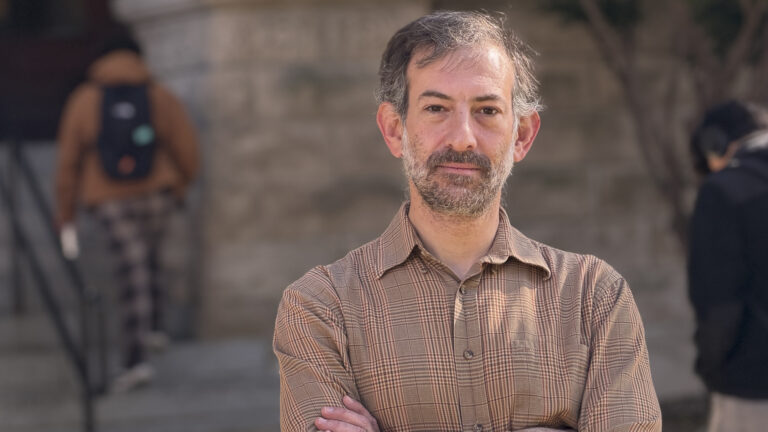
In this week’s final installment of America at 250: The Questions Before Us, we hear from Nicholas Grossman, a teaching assistant professor in the political science department at the University of Illinois Urbana-Champaign.
Grossman is editor of the Arc Digital Substack newsletter and author of “Drones and Terrorism: Asymmetric Warfare and the Threat to Global Security.”
The following transcript has been lightly edited for length and clarity.
If you traveled back in time to, to say, 2016, and you just laid out some of the things that were going to happen in America, totally factually, that were going to happen the next few years in America, just about everybody wouldn’t believe you. They’d say you were just being biased. You were delusional. No, that’ll never happen. Somebody will stop that.
And that clearly didn’t happen.
So, America, especially American democracy, is in bad shape. Maybe not quite as bad as perhaps before the election. But the United States is in a period of experiencing what political scientists call democratic backsliding, from democracy towards an authoritarian system.
And that doesn’t mean the United States is a dictatorship, but it’s not a full democracy anymore. It hasn’t really been operating under the Constitution, under the law, especially under Trump’s second term. And this has had profound effects on both the country and the world.
We have seen, throughout especially the 21st century, presidents get more and more authority relative to Congress. We saw this with Bush on the war on terror. We saw parts of this continue in the Obama administration. So we have seen power accumulate more and more in the executive branch.
But what we haven’t seen, what really made the 2016 election and 2017, Trump’s first term, so different is that even though we had a lot more power accumulating in the executive branch, we didn’t have nearly as much abuse of it. We didn’t have lawbreaking.
An easy, straightforward example of this is George W. Bush went to Congress for authorization for both the Afghanistan War and the Iraq War. And Trump, with the Iran war, not only did not get congressional permission, didn’t even bother asking for congressional permission.
So, early on in 2017, shortly after Trump took office, he proceeded to break a bunch of laws, to start disregarding Congress, and to stifle things like the law enforcement investigation into Russian electoral interference, for example, and to give people like his son-in-law security clearance, even though he failed background checks.
And to bring more corruption in the White House by holding on to all his private businesses and getting money from foreigners, including, for example, Saudi princes throwing money at him via his businesses.
The previous governments, they didn’t lie about elections. They didn’t file frivolous lawsuits. They didn’t try to overturn results. And that is the clearest difference between these last, now, ten years, and the time before that under either Republicans or Democrats.
Sitting where I do around — a little after — America’s 250th birthday, I am simultaneously optimistic and concerned.
The vision of America that is in the Declaration of Independence and says that all men are created equal, the vision that is in the Bill of Rights, that vision had a big comeback in 2026 and looks, at least at the moment, to be on the upswing. That does not mean that America is out of the democratic backsliding woods.
The president is still a highly corrupt lawbreaker. The White House is still usurping Congress’s power of the purse. They’re still conducting war illegally, without any say from the people’s representatives in Congress, and in direct violation of the laws of armed combat and U.S. law.
All of that will likely get worse, at least in the next two years, as the White House fights against Congress and, my guess is, will assert authoritarian power even more, if possible, and try to manipulate the upcoming election even more, given that many of them not only won political power, but potentially face loss of money and, especially, jail time.
And that, given that we saw a coup attempt in 2020, which was the last time that Trump was legally required to give up power, in 2028 it would be naive to think that there won’t be a coup attempt. There’s at least a risk of that also.
So, I think a big question for Americans moving forward is: Will the American people reclaim their democracy and build a pluralist, inclusive, democratic vision moving forward? Or will the United States continue its backsliding into authoritarianism and into more of a restricted and less free, less democratic country?
This story is the concluding installment of the Illinois Public Media series “America @ 250: The Questions Before Us.”
The project was conceived, produced and reported for IPM News by University of Illinois Journalism professor Charles Ledford. Additional reporting was contributed by University of Illinois journalism students A. Oishii Basu, Annisyn Krebs-Carr, Cooper O’Kelly and Fernanda Romero as part of their work with the Illinois Student Newsroom.
You can listen to all 21 episodes at ipmnewsroom.org/america-250/