

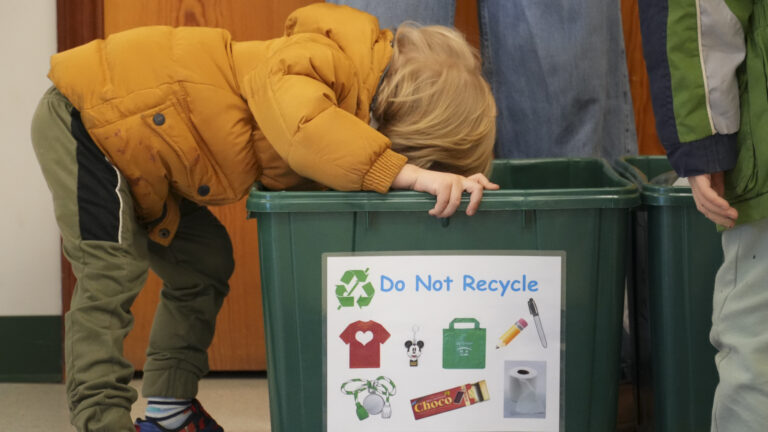
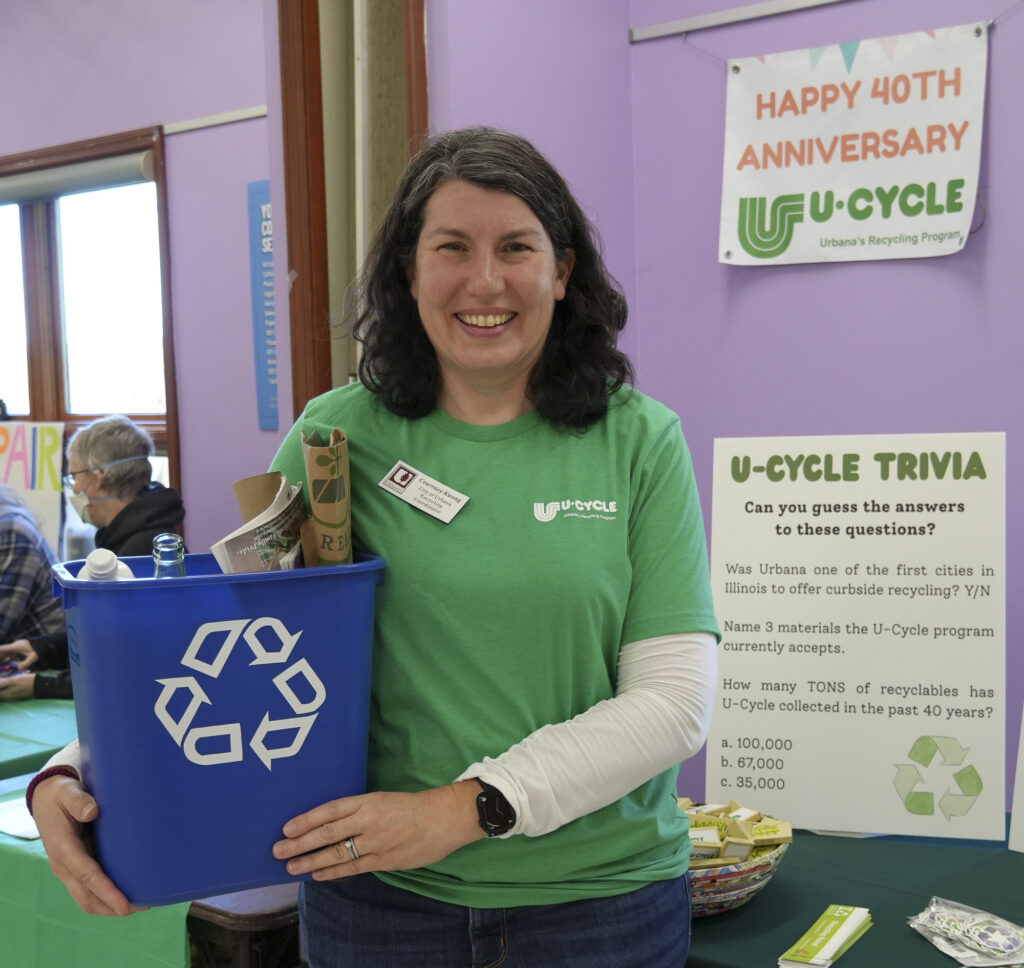
URBANA — The city of Urbana’s recycling program U-Cycle, established in 1986, celebrated its 40th birthday Saturday with crafts, games, a raffle and a recycling truck demonstration.
Courtney Kwong, Urbana’s recycling coordinator, organized the event at the Anita Purves Nature Center to educate residents about U-Cycle’s history, acceptable materials and alternatives to recycling.
“I just want to let people know that there’s a large history behind the program — what we started with and where we are at now has expanded quite a bit,” Kwong said.
Children and families colored recycling-themed pictures, read childrens’ books about recycling and practiced sorting objects into trash and recyclables.
The celebration also included a table run by The Idea Store, where guests could turn produce bags into pot scrubbers. And members of the Urbana Repair Cafe encouraged attendees to bring in non-recyclables that need repair.
U-Cycle then and now
At its launch, U-Cycle was one of the first curbside recycling programs in Illinois.
“We were the only community in downstate Illinois to have a curbside recycling program and so we’re very proud of that,” Kwong said.
U-Cycle started out only accepting three materials: aluminum cans, newspaper and glass, she said. Since then, they have expanded to accept different types of plastic and paper products.
In order for U-Cycle to accept a larger variety of materials, Kwong says there has to be a market for certain materials to be recycled, remanufactured and processed across the country.
“In the central part of the U.S., we’re able to basically send materials to the southern part of the U.S., to the east and west very easily and more cost-effectively than if we were to live on a coast,” she said.
Occasionally materials are sent overseas, but the transportation costs are much higher.
When U-Cycle began, it targeted single-family or four-unit housing. But in 1999, the program expanded to apartment recycling. According to Kwong, there were originally more contamination risks with apartment recycling, but they are proud to have been able to overcome that challenge so early on.
Back then, U-Cycle customers were still required to sort their materials into different containers. But in 2004, U-Cycle began its single-stream program.
“Folks didn’t have to sort separate materials, so they could put everything in one container … so that kind of expanded the program, made it more easy and convenient for people to recycle,” Kwong said.
Recycling FAQ
How much of what gets collected goes on to be recycled? Can Urbana residents bag their recycling? Should U-Cycle customers be rinsing everything before recycling — from milk jugs to detergent bottles?
“I always thought about that, cause then it’s so hard to get things right. And if some people do mess it up does that mean all the recyclables are going to go to waste?” said Ada Liew, a member of the Undergraduate Psychology Association, a registered student organization at the University of Illinois that volunteered to help run U-Cycle’s anniversary celebration.
In order for materials to be turned into something new, there needs to be a market for it.
“The recycling industry – it’s kind of like the stock market,” Kwong said.
For example, according to Kwong, over 25 years ago U-Cycle’s market expanded to include Number 2 plastic, high-density polyethylene, such as milk jugs, which were then turned into park benches.
When it comes to how much material collected actually gets recycled, Kwong said U-Cycle expects a 90% recycling rate.
“So there’s a 10% leeway just for stuff that could be contaminated,” Kwong said.
Contaminated materials can include more oily food containers, such as peanut butter or spaghetti sauce jars. Fortunately, she said, U-Cycle is able to rinse some materials on their own, taking some of the pressure off of the customer.
“It doesn’t have to be perfect, but those types of items we definitely want more rinsed out,” Kwong said. “…But it’s not as strict as it used to be.”
A bigger problem is grocery and garbage bags, according to Circular Services Operations Manager Kirsten Newby. She suggests residents not bag their recyclables and instead return grocery bags at local grocery stores, such as Walmart and Meijer.
“It’s such a stretchy material – when it goes through our sorting system, sometimes those bags can get wrapped around our belt system and it can stop up, which then requires us to shut down,” Newby said. “We have to pull it back out and sometimes it’s like concrete to get it back out.”
Circular Services is a pure-play recycler, which means they are not affiliated with any landfills, according to Newby. In 2017, Midwest Fiber, which was acquired by Circular Services in 2023, established Urbana’s recycling facility, where recyclable materials are sorted and processed, including those collected by U-Cycle.
For residents who still have questions about what can or cannot be recycled, U-Cycle can be reached at 217-384-2302.
“It’s fascinating to kind of learn more about how it gets sorted and what it can become,” Newby said. “I think the coolest thing that I’ve learned is that some of these plastics end up becoming carpet, and I would have never guessed that in a hundred years.”