

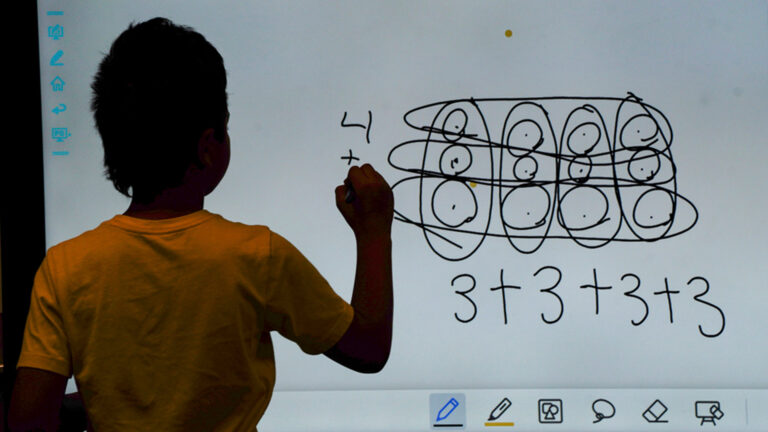
Math is a sore spot for many school districts in Illinois. Far fewer students are meeting state expectations for what they have learned in math class compared to English.
That’s partially because many districts have focused on improving literacy in recent years – and have made progress.
Urbana District 116 Superintendent Jennifer Ivory-Tatum said in a school board meeting on Tuesday that literacy has to come first.
“We know math is an opportunity for growth for us, but we also know that our students can’t engage with math if they cannot read and write.”
The Illinois State Board of Education released its annual Illinois Report Card on Friday, and state officials noted a statewide gap between math and reading levels.
In a press call, State Superintendent Tony Sanders said the gap shows that the literacy plan the state rolled out in 2024 has worked. Students are learning English language arts skills faster than they were before the pandemic.
Sanders said this is why the state published a similar “numeracy plan” in June. The document has information about which strategies for teaching math work, according to research.
Ivory-Tatum said Urbana has also spent millions of dollars in COVID-19 relief to bring up its reading scores. She said that money helped the district adopt a new curriculum, train staff and bring in experts, and the increasing number of students proficient in reading shows that those investments have paid off.
School boards in Champaign, Urbana and Decatur also discussed the Illinois Report Card at their regular meetings this week.
The staff and board members in Decatur District 61 agreed that the problem was particularly urgent for them.
Decatur has the lowest percentage of students proficient in math among districts in east central Illinois.
“To me, I find it unacceptable for our community to be that far below the state average at this point in time in 2026,” Decatur Board of Education President Bill Clevenger said. “If we make 5% improvement every year, how many years does it take us to get to the state average?”
Fellow board member Devon Joyner pointed out that scores are improving, slowly.
“We’re seeing some growth. We have not flatlined.”
He said the school district has to figure out how to improve those rates, but it also needs community support.
“The external challenge is we have a community that has not truly invested itself into helping. The district affects every one of us,” Joyner added. “They’re our children. They’re our workforce. So what are we doing outside of pointing fingers at each other?”
Champaign Unit 4 has a larger percentage of students meeting state expectations in math than other large districts in the area. It still ranks below the state average.
Multiple school board members and staff said math is an area of concern for Unit 4. District staff said they are reviewing potential new programs to adopt to improve elementary school students’ math skills.