

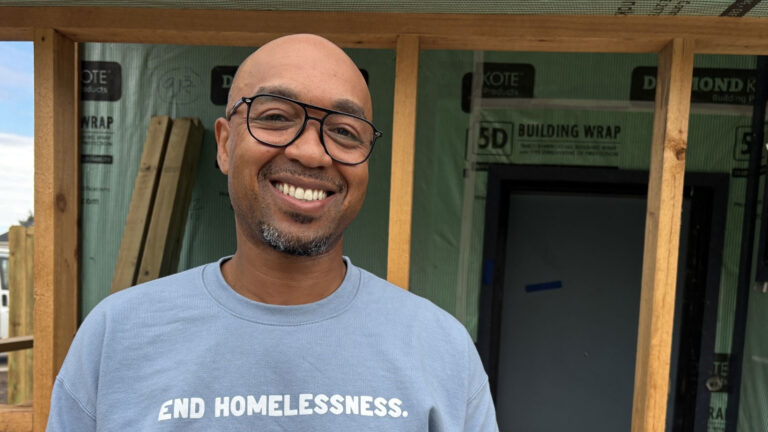
URBANA — A new community of small homes in Urbana — designed for people who are chronically homeless with complex medical needs — plans to welcome its first residents later this month.
With 24 one-bedroom homes located in north Urbana just south of I-74, Hope Village aims to connect the community’s most vulnerable residents to healthcare, case management services and other types of support, according to Executive Director Drew Martin.
“Hope Village is a place where people can come, they can rest, they can begin the journey of transformation and be able to live lives in a dignified fashion,” he said.
The housing community was launched with support from numerous community partners, including Carle Health, the University of Illinois Urbana-Champaign and the Champaign County Healthcare Consumers.
Funding for the housing development, totaling more than $12 million, came from the state of Illinois, the city of Urbana and local grant programs.
Aiming to serve the most vulnerable
The opening of Hope Village comes at a critical time, as homelessness is on the rise in Champaign County.
The latest count, conducted in early 2026, found 364 people in the area are homeless – up from 355 the prior year. Among them, 52 were unsheltered, 175 were sheltered in emergency shelters and 137 were sheltered in transitional housing.
Local initiatives to understand the causes of homelessness have revealed that many people who are homeless also have a disability of some kind — physical, intellectual or related to mental health, according to Katie Harmon, Continuum of Care coordinator for the Champaign Regional Planning Commission. She spoke with IPM News in September.
Being medically fragile and homeless makes it hard for people to find and keep a job and take steps to break the cycle of homelessness. And health risks are high for people who are medically fragile and living on the streets, Drew said.
“Whether you’re on oxygen [or] need constant wound care, maybe you have, you know, a certain stage of cancer, sickle cell, seizures — these are things that if not taken care of on a daily basis can land you into the hospital or death,” he added.
By providing stable housing to these residents, Drew said he expects to see cost savings over the long run.
“The cost of doing nothing looks like $60,000 to $200,000 dollars a year,” he said, referring to costs that arise when people living on the streets end up incarcerated or in the emergency department.
“So, what’s a thousand dollars in rent, right? …Do we just keep doing nothing and allow them to just keep getting arrested or going to the ER? Or do we do something about it?”
Hoping to make a difference, one resident at a time
Many community partners will be working to make Hope Village — a pilot project with “heavy investment” — a success, Drew said.
But there are some naysayers — “a lot of people that believe that this population of folks, that these neighbors that we have, shouldn’t deserve anything like this,” he said.
Drew wants people to understand that many who end up homeless have experienced incredible difficulties in life, often dating back to childhood, and they end up homeless at no fault of their own.
“If you heard the stories, if you just sat down and said, ‘How did you get here?’ more times than not, you’re going to [come away saying], ‘Oh, I can see. I understand,’” he said.
Rent for residents is capped at 30% of their income. Revenue from rent will go towards maintaining the property and paying down the mortgage, Drew said.
The rest of the funding — an estimated $500,000 a year to pay for case management, healthcare and other services, programming and operating costs – will need to come from fundraising.
Drew expects move-in for the first 24 residents to be completed by May 2027.
Illinois Student Newsroom’s Annisyn Krebs-Carr contributed to this report.