

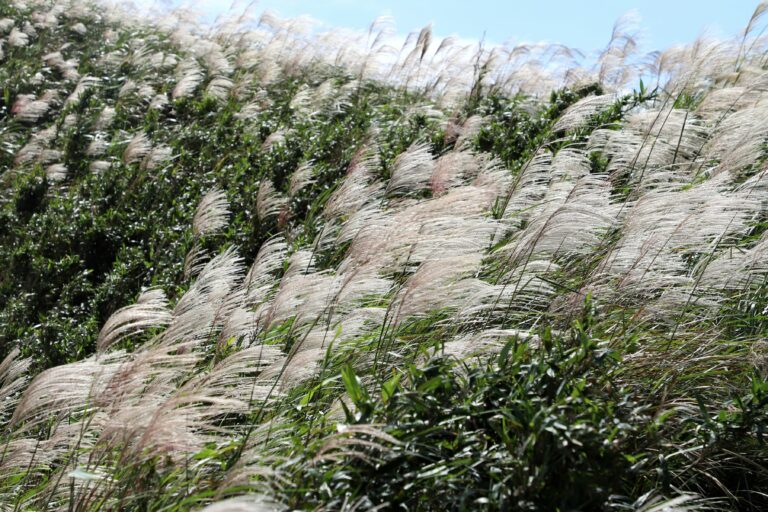
CHAMPAIGN – The University of Illinois Urbana-Champaign is hosting a first-of-its-kind summit on a grass plant that can be used for energy, building materials and more.
Miscanthus is a perennial grass plant — meaning it grows back every year without having to be replanted. It is found around the world, often in landscape settings, and can be used as a renewable energy source.
Researchers, farmers and policymakers from around the world will gather on campus this week to discuss innovations in miscanthus research and how and if it can become a widely used, profitable crop for farmers and a tool for renewable energy and bioproducts.
Researchers at the U of I have been studying miscanthus for more than 20 years, Professor of Crop Sciences Emily Heaton said, and have found it grows well when planted alongside corn and soybeans.
Heaton said the plant’s deep roots improve soil health and prevent soil erosion. And they grow for a long time.
“It’s productive for what seems like 20 years so far,” she said. “We still have our oldest stands here.”
The university is not only home to plots of decades-old miscanthus. It also houses a library of living genetic resources that can be used for research, Heaton said.
“We also have maybe the world’s largest germplasm collection here. Certainly, it’s one of the most unique germplasm collections,” she said. “It has entries from Russia all the way down to the equator. There are many places where we couldn’t collect those plants today. And so we want people to know about this resource.”
Researchers at the U of I are eager to collaborate and work more closely with other researchers, farmers and policymakers on miscanthus research and economic development, Heaton said.
“Farmers are very interested in miscanthus,” she said. “They have the same questions for miscanthus that they have for other crops: ‘tell me about the markets. Tell me about the infrastructure. How does my contract work? Who’s my buyer?’”
Andrew Leakey, director of the Center for Advanced Bioenergy and Bioproducts Innovation at the U of I, hopes the summit produces innovation and partnerships that can build out the infrastructure to answer these questions.
“We’re really hoping we will derisk the adoption of these things, so we already have farmers who are expressing interest in growing miscanthus,” he said. “We already talked to companies who expressed interest in receiving miscanthus in order to turn it into products.”
On top of the myriad of environmental benefits, miscanthus also doesn’t need a lot of fertilizer, Leakey said, which is good for the environment and farmers’ pocketbooks.
“It’s also important economically, because fertilizer inputs are one of the more expensive elements of farming,” he said. “So as a farmer you can be more profitable if you produce more product while spending less to do so.”
And it doesn’t compete with production of corn and soybeans, Heaton said, giving farmers another revenue stream during the offseason.
“Perennial crops in particular not only provide a crop that can be harvested in a different time of year, so it doesn’t compete in the harvest window of corn and soybean,” she said. “You can harvest miscanthus any time over the winter, really, and then when those perennial crops grow, they protect those soil resources. So you don’t have dust storms when you have miscanthus growing.”
Miscanthus can be burned for heat and power, turned into building materials and used for animal bedding, Heaton said.
“There are now over 20,000 acres of miscanthus in the United States. Some of those are here in Illinois,” she said. “There’s a large growing expansion in the eastern shore of Maryland, where it’s use for poultry bedding.”
Heaton and Leakey hope this week’s summit will lead to new innovations and partnerships that grow the use of miscanthus in the Midwest, specifically in Central Illinois.
“We would be able to do vertically integrated supply chains, where not only do we grow the crop, but we turn it into stuff here. And we sell it here,” Heaton said.
For example, one project would use miscanthus to create plywood boards in the Peoria area, she said.
The summit includes sessions on supply chains, biofuels and policy frameworks for growing the miscanthus bioeconomy.