

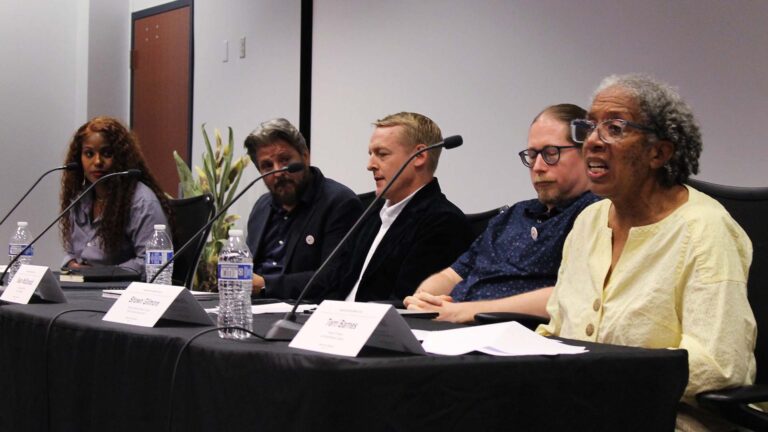
CHAMPAIGN– Professor Terri Barnes has been trekking up and down stairs across the University of Illinois Urbana-Champaign campus, knocking on doors to make the Campus Faculty Association more than a loose association of tenured and tenure-track faculty.
The history and gender studies professor and others in CFA want to make it is an official union by the spring.
“I’m happy with my salary. That’s not why I think we need a union,” she explained.
“I think we need unions so that we can be in solidarity with the other folks on our campus. So that we have a seat at the table when our university is making really important decisions about how to respond to all of the things that we’ve been talking about here today.”
Barnes said that at U of I, the biggest impact of the Trump administration’s focus on higher education has been to destabilize the lives of international faculty and students, from proposing new application fees to changes to internship rules.
She called the changes unwarranted and cruel.
Panel makes case for unionization to counter Trump policies
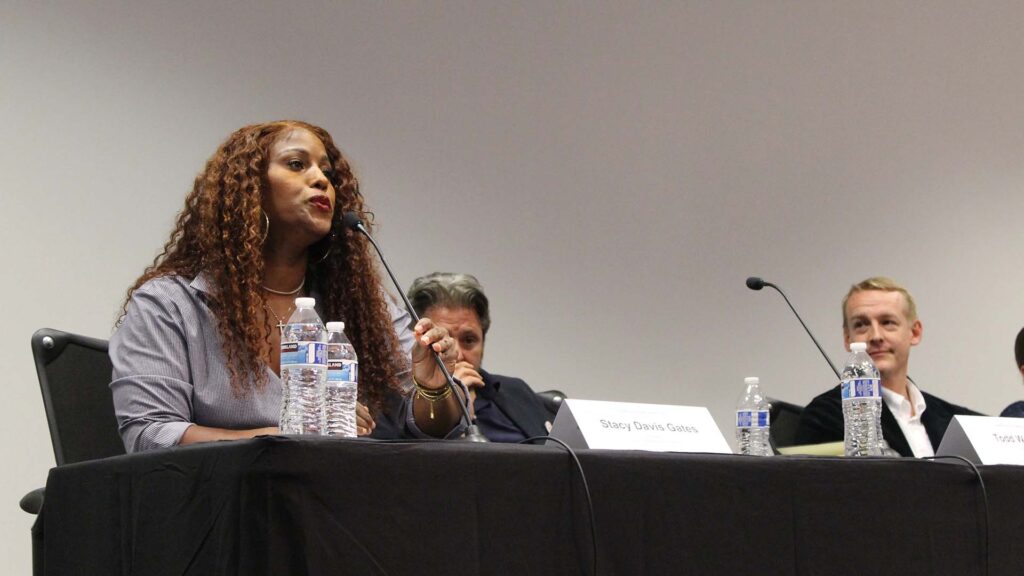
CFA hosted a panel Tuesday focused on attacks on higher education, where Barnes and heads of other unions pitched unionization as the way to fight back.
American Association of University Professors President Todd Wolfson summarized some of the ways the Trump administration has been reshaping higher education during his second term. This includes detaining students based on their support for Gaza, forcing biomedical labs to close by taking away their funding and trying to reduce faculty governance and affect subjects taught at institutions like Columbia University.
Trump has argued these actions are necessary to counter a far-left or “Marxist” bias at universities.
“I think every single one of us in this room has lost at least one year in our life expectancy because of the Alzheimer’s therapy, the cancer therapy, the diabetes research that will not be there when we need it because they closed our labs,” Wolfson said.
Wolfson said that just among the leaders in the union and membership association, 20 cancer labs faced extended closures in the past 18 months.
“But I do want to say to make sure we understand that this attack didn’t start with Trump and it didn’t start with [Florida Governor Ron] DeSantis,” Wolfson said. “It’s really easy to come after us because we were hollowed out from the core.”
Wolfson explained that hollowing out began in 1970. He said California Governor Ronald Reagan saw that universities were becoming free and that they were the centers of political movements. Reagan said that charging students for higher education “might affect those who are there really not to study but to agitate, it might make them think twice about paying a fee for the privilege of carrying a picket sign.” As president, Reagan reduced federal spending on higher education and student aid.
Wolfson said that divestment has continued, shifting the costs of college to students. He said universities have responded by shifting teaching responsibilities from tenured faculty to short-term teachers who are paid less.
“So that means that substitute teachers, that we call guest teachers, are being used instead of certified teachers”, fellow panelist Stacy Davis Gates questioned. “Yeah. You need a union.”
Davis Gates is a high school teacher and the president of the Illinois Federation of Teachers and the Chicago Teachers Union.
She told the panel audience that unionization has the power to do what other actions cannot. Gates said she recently visited Hungary, where almost 80 percent of voters turned out in April to end the 16-year term of far-right nationalist Viktor Orbán.
“The only thing that I’ve seen in 80% votes in American society is what labor unions get to do,” Davis Gates said. “I submit to you that the only way that you get 80% is by practicing solidarity with people who are different. A labor union gives you a safe space with guardrails, leadership and process rooted in democracy that gives you that chance.”
Faculty unionization picking back up at U of I
The pressure coming from the Trump administration is an important case for unionization, but the energy and “motivation for a campaign had been building up for a long time”, according to Barnes. She said she was part of an earlier push to unionize all U of I faculty in 2014 and that effort resulted in a new union of some faculty members, the Non-Tenure Faculty Coalition.
Barnes has helped facilitate talks with faculty from departments across the university, asking them to sign cards that say if a union exists for them, they will join it. She said that if over 50 percent of faculty sign those cards, that will create the union.
Barnes also said the goal is to get over 50 percent of tenured and tenure-track faculty to sign the cards by early next year.