

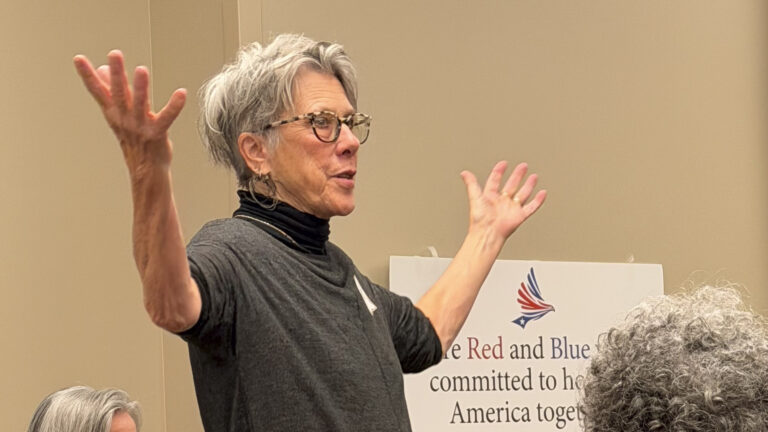
MAHOMET — Who should have the power to draw Illinois’ district lines? Champaign County community members debated that question Monday, Sept. 28, at the Mahomet Public Library.
Over the years, efforts have been made to create an independent commission to redraw district lines in Illinois — without success.
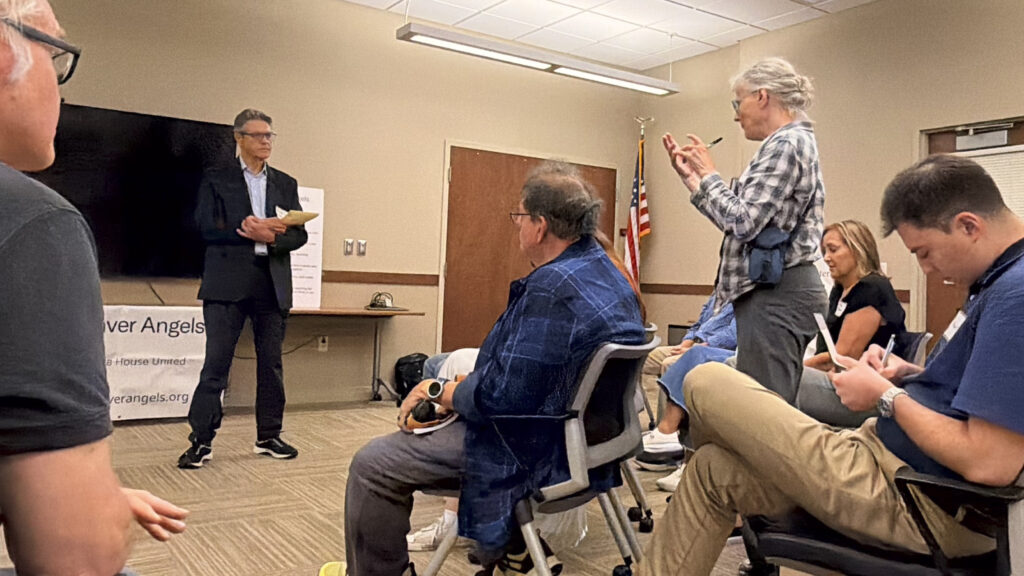
The debate was hosted by Braver Angels, a nonpartisan organization that promotes civil discourse between people with different political views. Participants discussed the potential benefits and challenges an independent commission could present.
At 6:25 p.m., participants began filing into the Mahomet Public Library conference room.
They were greeted at the door by Lesley Dzik, the red co-chair of the Braver Angels Alliance local chapter, and were seated around a semi-circle of chairs facing the front of the room. Around 30 people participated in the event.
What would it take to create fair maps?
Supporters of an independent commission argued that the approach would take away the authority to draw district lines from politicians who could use redistricting as an attempt to stay in power.
One participant added that this would be beneficial because it would not involve “any cheating like gerrymandering does.”
Supporters also argued that independent commissions should be adopted nationwide, not just in Illinois.
Others said they believe gerrymandering is a significant contributor to the political division seen across the country. They argued that a bipartisan independent commission could help unite the country by removing the power of drawing district lines from politicians who could use it to their advantage.
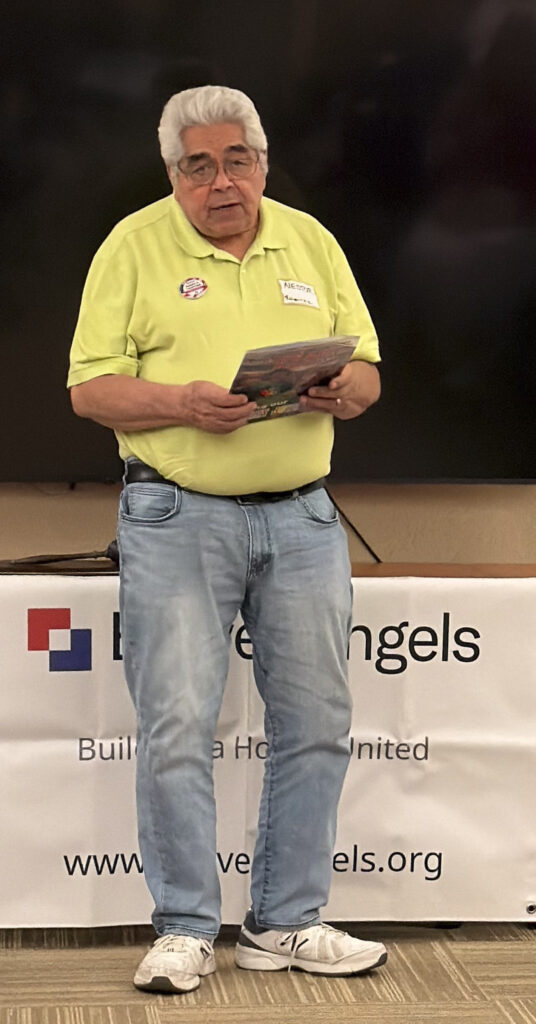
Nestor Ramirez, a Champaign resident, believes an independent commission should bring both major political parties into the process rather than allowing either party to control the maps.
“I would create a panel that was agreed [on] by everybody,” Ramirez said. “I would have the blues [Democrats] choosing the reds [Republicans] and the reds choosing the blues.”
Ramirez explained the idea would prevent either party from choosing their own representatives on an independent commission. Instead, each party would select representatives from the opposing side.
He believes the commission should focus more on working together to represent citizens rather than on partisan differences and preserving political power.
However, some participants, while voicing agreement with concerns regarding gerrymandering in Illinois, questioned whether an independent commission would resolve it.
One participant said that states are represented by those their communities elect, and those elected should represent the interests of the people they serve. If lawmakers do not do that, he said, they simply will not get re-elected.
Another argued that when redistricting occurs, legislators should state their intent behind the changes. Additionally, they said districts should be geographically connected, should not over- or underrepresent minorities and should not be drawn to maximize political advantage.
Some voiced concerns that a bipartisan independent commission would not truly be bipartisan. They argued that people are inherently biased and will seek out advantages when possible.
Matthew Dzik, a Champaign resident and the blue co-chair of the Eastern Illinois Braver Angels Alliance, said the issue is more complicated than removing politicians from the redistricting process.
Dzik also explained that while an independent commission seems great in theory, he questions how it would actually work in practice.
“How [do] you take all these groups into account and make everything fair? No matter how you do it, somebody is going to think it’s unfair,” Dzik said.
Some participants suggested that Illinois should move away from people making the maps completely, in an effort to remove politics from the equation. One participant said computer systems could be used to group people geographically, starting with Chicago and following county lines.
Another said maps could be created using generative AI.
The discussion comes as Illinois lawmakers consider a proposal to change how Illinois should draw its district lines in the future.
A Senate proposal stalls in committee
Illinois State Sen. John F. Curran (R-41) proposed an amendment to the Illinois Constitution in January that would create an independent redistricting commission.
Curran’s proposal would create a 16-person commission that reflects the same ethnic, gender and racial demographics of Illinois.
The Illinois Supreme Court Chief Justice and the most senior Supreme Court Justice elected from a different party would select the commission members, which would include seven Democrats, seven Republicans and two individuals who do not belong to either party.
The commission would then create proposed legislative, representative and congressional maps based on population, geographic and election data.
The maps would be required to follow the Voting Rights Act.
The proposed legislative and representative maps, along with the data used to create them,would then be sent to the Legislative Redistricting Committee. The proposed congressional map would be sent to the Illinois General Assembly for approval.
In response to questions for this story, Curran’s office said the proposal remains pending in the legislature.
Over the past year, more than a dozen states have attempted to change their congressional maps. Seven states currently use partisan-balanced independent commissions: Arizona, California, Colorado, Idaho, Michigan, Montana and Washington, according to Common Cause.
Curran’s office said the Illinois Republican Caucus will also be filing redistricting legislation in 2027, but no details about the proposal have been released.