

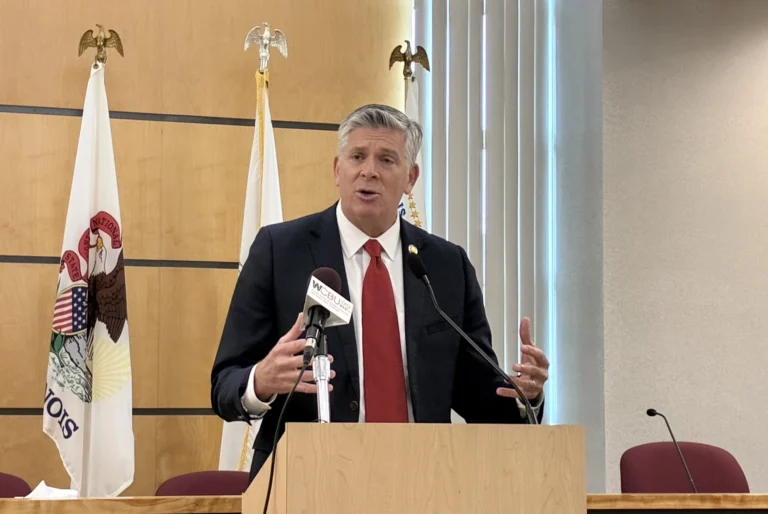
Representative Darin LaHood is campaigning for a sixth term representing Illinois’ 16th Congressional District. His district includes a large part of rural northern Illinois — starting in Galena, then snaking east and south — wrapping around Rockford, Peoria and Bloomington — but avoiding the urban cores of those communities. Democrats in Springfield drew the map this way to maximize the number of Republicans in the district. Since the district boundaries were redrawn, LaHood won with about two thirds of the vote in 2022 and in the last election cycle, he was unopposed.
This year, LaHood again faces a challenger, Democrat Paul Nolley. LaHood joined the 21st Show last week to make his case for another term while discussing hot topics such as skyrocketing gas prices, what the Iran War has accomplished so far as well as viable solutions for legal immigration. Nolley joined the program last month.
Interview Highlights
On gas prices
“You know, there’s been some talk about a suspension of the federal gas tax, which will have a minimal effect, but will send a message that we need to work on reducing gas prices. There’s also a proposal currently in the Senate right now to restrict exporting of diesel outside of the United States. Senator Grassley has advocated for that, which will help on diesel prices. I know that’s under contemplation right now.
But the bottom line is, because of the conflict in the Middle East, the Strait of Hormuz has not allowed oil to appropriately flow through, and so we’re in the situation we are right now.”
On pros and cons of Iran War
“Iran has no more ballistic missiles that can harm the United States. They don’t have any hypersonic missiles that can harm our allies in the Middle East. We’ve destroyed their navy. We’ve decimated their nuclear weapons. But unfortunately, because of drones, they’ve been able to still use drones to go after some of the ships and other things in the Middle East.
There’s no doubt when you zoom out and think about years ahead, the Middle East will be a safer place because of the action we’ve taken. And the world will be a safer place for that. But I think what we’re finding is it’s much easier to get into a conflict than out of a conflict right now. And I think specifically because of drone technology, Iran has been able to cause the Strait of Hormuz to be disrupted, and that’s obviously causing the high price of fuel.”
On tariffs
“I think tariffs should be used in a more nuanced way to go after countries that don’t abide by the same rules and standards that every other industrialized country in the world does. I frankly — and I’ve said this publicly — tariffs are the Achilles’ heel on the economy. That 10, 15, 20% tariff that’s added on to goods is not good for my farmers. About 40% of the corn and soybeans grown in my district go somewhere else around the world. They get loaded on barges on the Illinois and Mississippi rivers, go down to New Orleans, and go around the world. We need more markets and customers.
And I’ve publicly advocated for that. I’ve expressed that in public hearings to our trade ambassador, Jason [Greer], to the president and his team. We should not predicate our economic policy on blanket tariffs. It hurts our manufacturing and it hurts our agriculture industry, too. So I’ll continue to take that position.”
On deportations and pathways to legal immigration
“We ought to be sending people that are criminals back to their country of origin, which we’re doing. We ought to have an immigration system that gives people the legal due process they deserve in the court system. But if they’re here illegally, they ought to go back to their country of origin.
I say all that as — it doesn’t mean we shouldn’t fix some of the problems related to ICE and the reduction of the violence and some of these things that have gone on. I’m supportive of that. But I’m also supportive — and I’ve introduced legislation on this — to have a legal immigration system that allows more people to come to this country legally. I have a bill that I’ve introduced that would basically double the amount of legal immigrants that come to our country over the next five years. It would streamline the process so it doesn’t take five or four years to come to this country. I would also streamline their process to make sure we’re bringing in more skilled labor to the United States. ”