

CHAMPAIGN — A birthday is a time for celebration and reflection: Where have we been? Where are we right now? And where are we going?
IPM is celebrating America’s 250th birthday by inviting people from across east-central Illinois to share what they think are the most important questions facing Americans at this historic moment.
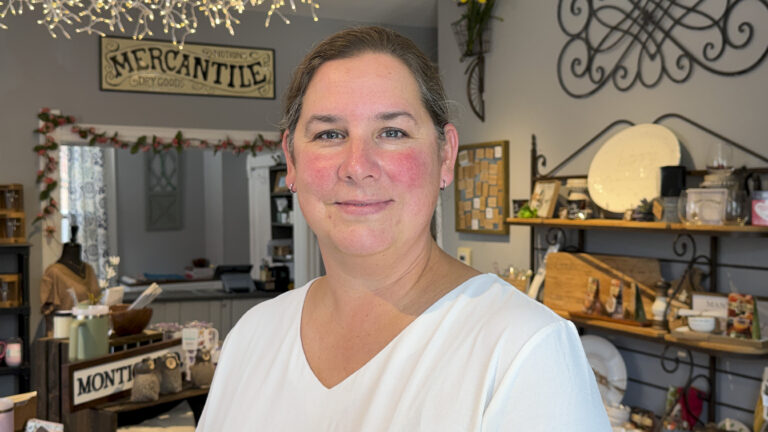
Callie McFarland has lived in Monticello since 2004. She’s a mother of two, a farmer’s wife and a small business owner. Since 2008, she’s been the director of community and economic development for the city of Monticello.
McFarland says her family enjoys traveling, building and pulling antique tractors, and providing a home to a collection of wayward animals — when they’re not working, that is.
The following transcript has been lightly edited for length and clarity.
My husband and I are both, we say, undiagnosed ADHD. We cannot sit still. We don’t know how to relax. That is not a good thing.
Whether it’s me going before work to one shop to do paperwork, then going to my job, and then lunch hours are either at home to check on animals or a child or go to another shop to catch up on paperwork, back to my day job. It’s exhausting, to be quite honest with you.
But by the same token, we’re teaching our children that nothing’s handed to you. You have to work for what you have. Sometimes things don’t go as planned, and what matters is how you come out of it. It’s just life, right? There’s always going to be another day. So how are you going to accept, embrace, and move on?
So, 250 years of America, I’m still proud of our country as a whole. I still think we are the land of opportunity. I still think the American dream is real. I think we need to not ignore the cornerstone of what we were built off of.
We created the Constitution, the Bill of Rights as kind of a baseline. And yes, things change over time, but I think how we’re handling it is the contentious part.
Social media has made the lack of accountability to our detriment because you’re basically screaming in someone’s face whatever you want and then walking away and not really caring. You don’t see what their reaction is. You don’t see the harm that it causes.
And I think that has desensitized us in terms of how to treat a person and how to engage and react and understand, whether it’s a facial expression like, “Oh my gosh, that really hurt,” or “Oh my gosh, I totally agree with you.” That’s gone. That’s out the window. And because that accountability is lost, we forgot how to be human.
I am a little fearful for where we stand, especially as you see more and more instances of, “well, their idea is different than mine” — whether it’s their belief, their view, their appearance “is different from mine.” “So they’re crazy,” or they automatically get labeled as something, and that is very worrisome to me.
I grew up in southeast Urbana — tight-knit, houses every six feet or whatever. But when I moved to Monticello, it was a totally different vibe. We’re a Hallmark downtown.
It is a traditional square with a courthouse still in the middle and functioning, which is very rare. If you met Joe Citizen on the street, they might have opinions different than yours, but, again, it’s that face-to-face interaction that is going to be a lot different than somebody posting something on social media, right? Golden Rule: “Treat others as you would treat yourself.” That sounds very kindergarten, but it’s true.
We need to become more empathetic as a country and not automatically discount someone because their view is different from ours, but understand why they feel the way they do, instead of automatically putting the hammer down and “Nope, this discussion stops. You’re automatically wrong.”
America’s whole history was built off of conflict, right? We’re constantly going to be evolving and changing — whether it’s change in rights — women’s rights, civil rights, LGBTQ, all sorts of things. That is where conflict arises, because I’m right, you’re not, you’re wrong.
I don’t think I’m fed up, I think I am more disappointed with what I see as steps back. I feel like we had come such a long way, and it had not been easy, and then it just seems like almost overnight we took four steps back.
As we move forward, this is still the greatest country. Monticello, Illinois, is still the greatest community for me.
I have been accused many times of being young and naïve, even though I’m not young… gray hair, right? But I refuse to become a hater.
I’m always going to make the best of the situation that I’m in. We just need a little empathy and to get back to interacting and engaging and listening and working together to move forward.
I think the question we need to ask ourselves to accomplish that is: What do we want to be when we grow up?
This story was reported by University of Illinois Journalism Professor Charles “Stretch” Ledford. If you have an idea for the America @ 250 series or would like to be featured in an upcoming story, please contact Stretch at stretch@illinois.edu.