

This story is part of America @ 250: The Questions Before Us, a series from IPM News and the Illinois Student Newsroom.
CHAMPAIGN — A birthday is a time for celebration and reflection: Where have we been? Where are we right now? And where are we going?
IPM is celebrating America’s 250th birthday by inviting people from across east-central Illinois to share what they think are the most important questions facing Americans at this historic moment.
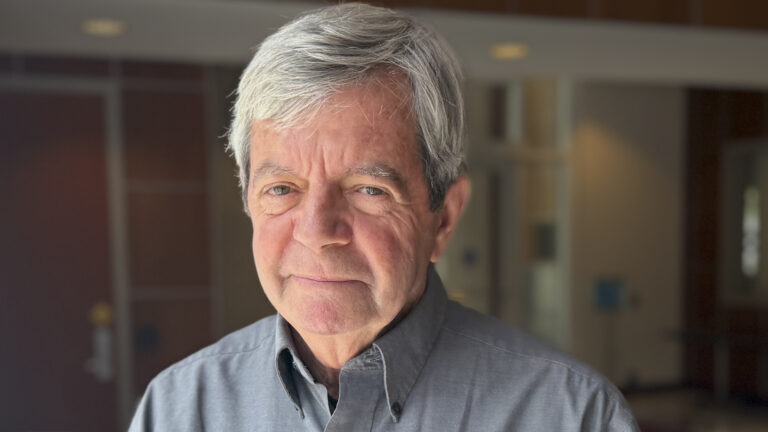
In 2025, Champaign psychiatrist Dr. Allan Crandell retired after 17 years of seeing patients in central Illinois. He practiced at Christie Clinic, the Developmental Services Center, Piatt County Mental Health and Coles County Mental Health. Allan has also provided psychotherapeutic treatment and medical services to vulnerable populations in Arizona, New Mexico, Alaska and Colorado.
The following transcript has been lightly edited for length and clarity.
America is a very lonely country. People will talk about being lonely. They’ll talk about being separated from their families or their friends.
I think overall there’s what’s been called a cultural pessimism. People in society look ahead and don’t see the bright and shiny path that maybe their parents or grandparents saw. The number of people who are depressed or anxious seems to be accelerating. It’s aided and abetted by the fentanyl and meth crisis.
When I grew up in Denver in the 1950s, all seemed relatively glorious. There were lots of jobs. The war was over. They were building houses everywhere. If you go to Colorado Springs, you can still see tract houses that stretch for miles. The future seemed to open.
You could have any job you wanted: a forest ranger, physician, astronaut. But I think over the last—it’s hard to say—after the last 10 or 15 years, that image has certainly eroded. It’s hard to find what gives us meaning other than the chance enjoyment of the internet.
And that makes me feel worried about our American culture and probably a little lonely myself.
If you read any of the news, any time of day, on any platform, it is, let’s say, disenchanting. We’re involved in a war that I think very few people saw coming. We are somehow going to fund a $1.5 trillion defense budget, and yet we don’t have enough money to address homelessness. We don’t have enough houses for people to live in. I see a lot of people just around town who have two or three jobs just to pay for their apartment.
I certainly hope we have another 250, but I think the promise of the first 250 is tarnished.
I think the rise of billionaires and the subtraction of money from public projects, the lack of public space, I think the lack of support for libraries, I think the lack of support for public schools—I don’t think there are very many degrees of separation. I think it’s all connected.
I saw it play out daily when I did my work in Denver, Colorado, with the people who are unhoused. These are people at the very bottom of the social structure, but I think somehow the very most abject person I saw in Denver is connected directly to people making billions and billions of dollars. I think there’s a direct connection between the two.
I think when you subtract money from the economy, from public schools, from public housing, from public healthcare particularly, from public media, and it all goes upward, then what’s the result? The result is despair and discouragement.
As Americans, we were always can-do people. We could get it done. We were the leader of the free world. We went to the moon. We could solve poverty. We had this social project to lift everybody up, to provide welfare for as many people as we could. And I think we’ve abandoned that project.
I think we have to ask ourselves the hard question of American identity. Really answer the question: Who are we in our country, and who are we in the world? And who do we want to be? Are we a country that just has an ever-expanding military budget? Are we a country who simply wants to acquire territory? Are we a country so entranced with the internet that we can’t see our neighbors?
I would hope that we would remember the welfare of all and come to our senses, quit chasing things, quit immersing ourselves in the internet and really get involved on a local level.
Know your neighbors. Be with your neighbors in a community project, whether Republican or Democrat. Find something useful to do so, at the end of the day, you can say, ‘I did something. I helped one person. I developed one project. I picked up a piece of trash on the street,’ whatever it is. I think we need, as human beings, concrete things to look at to say, ‘Yes, that made a difference.’
I think we would be happier. I think we would be more connected. I think we would have a sense of meaning.
We’re a very, very wealthy country. We could do better. We could do better here in the streets of Champaign-Urbana. We could do better in the world. We have the resources if we just had the will to remember our, probably our better angels, as Lincoln said.
This story was reported by Cooper O’Kelly. America at 250: The Questions Before Us was conceived and produced for IPM News by University of Illinois Journalism Professor Charles “Stretch” Ledford. If you have an idea for the America @ 250 series or would like to be featured in an upcoming story, contact Stretch at stretch@illinois.edu.