

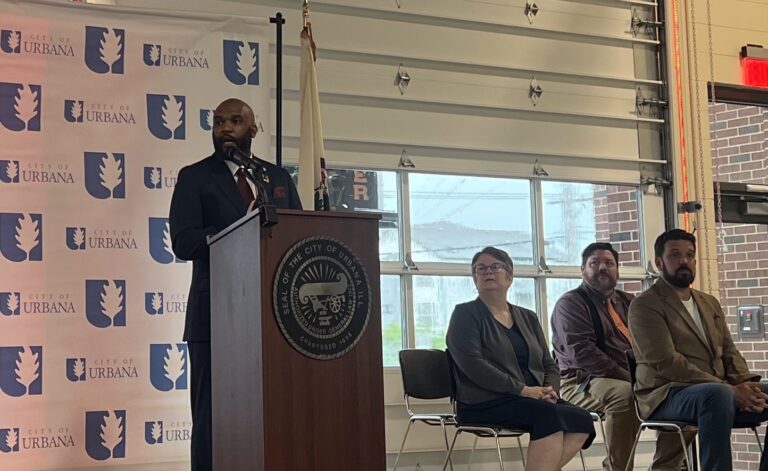
URBANA — Urbana Mayor DeShawn Williams spoke about public safety, infrastructure improvements, accessibility and public input in his first State of the City Address at the Urbana Fire Station No. 3 on Wednesday.
Public Works
The mayor said that since August 2025, the public works department has responded to more than 1,300 requests from residents concerning pot holes, trees, sewer and traffic issues.
He also discussed surveys that the city has asked residents to complete, including the Lincoln Avenue Complete Street Demonstration Project and the community needs survey.
According to Williams, 49% of Urbana residents that responded to the community needs survey said street lights need improvement in their communities. He said that this fall, the city will install 15 new street light poles and luminaries along Harding Drive, Brighton Drive, Vawter Street, Mitchem Drive and Silver Street from Cottage Grove Avenue to Philo Road.
He also acknowledged the ongoing sidewalk improvements along Harding Drive, Cottage Grove Avenue and Vawter Street in the Silverwood neighborhood.
Williams noted the city’s 2027 budget allocation to the new Philo Road Ahead Initiative Program. This program will launch with $50,000, and by matching grants, will help property owners and businesses invest in improvements including beautification, safety and exterior property enhancement.
“Improvements such as landscaping, parking lot resurfacing, exterior lighting and fence repairs will help strengthen the corridor while encouraging additional private investment,” he said.
Williams said the program is in the process of being developed and is expected to launch in the coming year.
“Economic growth takes partnership, takes planning and patience. And the decisions we make today will help create a stronger Urbana for years to come.”
Public Safety
Through July 29, 2026, Williams said that reported property crimes have gone down by 28% compared to the previous year, and violent crime has decreased by 8%.
The mayor recognized the efforts of city fire fighters and police officers in the past year. He said the Urbana Fire Department responded to nearly 6,700 calls for service, and the Urbana Police Department seized 90 firearms connected to 63 incidents.
“A thriving community begins with safety,” Williams added. “Public safety is not only about responding when an emergency happens. It’s about preparation, prevention and building trust before residents ever need to make the call.”
As such, Williams explained the city’s long term plan to maintain and replace their fire apparatus fleet, including acquiring a “quality, pre-owned ladder truck” to maintain aerial response while being financially responsible.
He said the fire department has historically only operated with one ladder truck, and while the primary truck is going through repairs or other emergencies, they need to be able to serve the 800 buildings in Urbana that are three stories or taller. And nine firefighters are continuing to work towards EMT certification for continued public safety.
Williams also said that the city remains committed to finding and holding accountable individuals responsible for illegally supplying firearms that contribute to the community’s violence.
“While illegal firearms are not the only factor contributing to violence, reducing their availability is a critical part of creating lasting change and building a safer Urbana,” he said.
Housing
In the past year, Williams said the Urbana Building Safety Division protected residents by conducting more than 750 proactive inspections, nearly 3,500 rental unit inspections, over 1,500 follow-up inspections and nearly 800 nuisance issues addressed.
The city also purchased the Pickerill properties along Cunningham Avenue to allow for future redevelopment opportunities.
“After more than two decades, this represents a new chapter for that area,” he said. “One focused on investment, economic activity and creating opportunities that benefit our residents and visitors.”
The city launched the Urbana Housing Needs Study with the Champaign-Urbana Regional Planning Commission between December 2025 and July of this year. Williams said this effort will allow the city to better understand the housing challenges facing the Urbana community.
Now, five apartments on Silver Street and Fletcher Avenue are being renovated to create additional housing and strengthen the surrounding neighborhood. Over the past year, Williams said 53 new homes were built in Urbana to better serve the growing community.
Community Engagement
According to the mayor, Urbana’s community engagement team participated in 59 events and over 600 hours of outreach with residents, youth and community partners. The city is working to expand this work through a new Community Engagement and Violence Prevention Office, as well as a dedicated Community Engagement Liaison position.
“These investments recognize that preventing violence requires more than a response after harm occurs,” Williams added. “It requires mentorship, connection, opportunity and support for the young people and their families.”
Grants and Funding
According to Williams, Congresswoman Nikki Budzinski has requested $250,000 for congressional community project funding appropriation to support Phase 1 of the South Lincoln Avenue improvements between Florida Avenue and Green Street.
“While the funding remains subject to congressional approval, it represents another important step towards improving one of our key transportation corridors and preparing for future growth,” he said.
Williams expressed his gratitude for state senator Paul Faraci’s request for $250,000 in state appropriations through the Bill Illinois Bond Fund for infrastructure improvements in the community.
He also recognized the city’s investments, including $90,000 given to local artists and organizations through the Urbana Arts Grants.
Other Improvements
This past year, Williams said Urbana has strengthened their ADA accommodation process, expanded translation and interpretation services and updated their transition plan to improve accessibility throughout the community.
He also said the city began developing its first racial equity plan, to ensure that equity remains a part of how Urbana makes decisions and delivers services.
Since taking office, Williams said the city has welcomed 44 new employees, promoted 26, and appointed seven executive leaders, including the city administrator, community development services director, fire chief, public works director, city engineer and two deputy police chiefs.
In June, Urbana City Council passed a balanced budget for the 2027 fiscal year.
Looking Forward
Williams said the city will continue to focus on five main priorities moving forward.
“First, we will continue building safer neighborhoods by supporting our police officers and firefighters, expanding prevention efforts and strengthening partnerships through our community.”
The city’s second priority includes investing in infrastructure to improve daily life and prepare for the future. The third priority is to continue creating opportunities for economic growth.
The fourth priority will be to continue addressing the housing needs of residents and lastly the city will continue to strengthen the relationships between City Hall and Urbana’s residents, Willams said.