

This story is part of America @ 250: The Questions Before Us, a series from IPM News and the Illinois Student Newsroom.
URBANA — A birthday is a time for celebration and reflection: Where have we been? Where are we right now? And where are we going?
IPM is celebrating America’s 250th birthday by inviting people from across east-central Illinois to share what they think are the most important questions facing Americans at this historic moment.
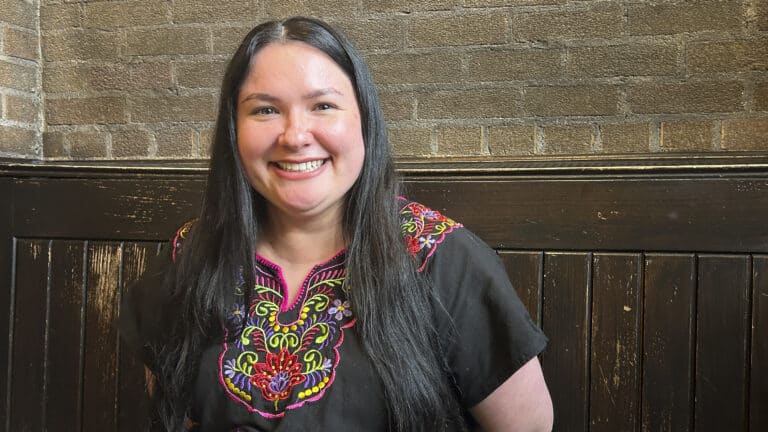
Hannah Velasco is a 29-year-old resident of Urbana. She directs Urbana High School’s Ballet Folklórico de los Tigres and is a recruitment and training coordinator for the Court Appointed Special Advocates of Champaign County. Her identity has never fit neatly into one box, and she believes that accepting each other’s differences is part of being American.
The following transcript has been lightly edited for length and clarity.
I think part of the Latin American experience is resiliency. And it’s very much a story of survival. You know, regardless of where we’re actually coming from, we don’t have the same access to materials. We don’t have the same access to spaces. So we learn skills to make things work for us and to kind of make the most of what we do have. And we eventually get really, really, really good at what we do. And I think it’s really beautiful.
My name is Hannah Velasco. My pronouns are she/they. I was adopted. My birth father is Mexican and my birth mother is Polish. So I’m, like, Polexican, if you will.
There’s a lot of, like, misunderstandings of what it means to be Mexican, how, like, you have to be connected to an immigration story, and you have to only speak Spanish at home. And there’s all of these, like, cultural expectations that people have. I try not to, like, overly claim one side or the other side of my identity because I was adopted, and I deal with a lot of imposter syndrome. And I think part of that is like any cultural experiences I have with my Mexican side, like, it was never in my parents house, it was always outside of the house. And then, on my Polish side I don’t have any experiences with that apart from, like, Polish food.
I think part of being like, I don’t want to say a ‘good American’ because that feels really controversial, but being able to like acknowledge different families histories the effects of privilege, the effects of, you know, being historically oppressed, being accepting of that and acknowledging that is a huge part of being an American. At least it should be.
Like, who are you to say who can and cannot be in this country? Like, who the hell are you to say that? Don’t tell me about the mission trips that your church is going on, don’t tell me about how you’re raising money for charity if you don’t give a sh– about people who already live in this country and are struggling to get by.
The Constitution applies to anybody within U.S. borders. So I don’t understand why people are picking a fight with undocumented immigrants. I don’t get it.
I don’t think I’m in a point where we can’t be political. I think everything is political. But Trump being elected in 2016 really was when, like, fear, I think, started becoming very real for myself, for my spouse’s family. It really, really freaked me out. It was really, really scary.
And I know that there’s, like, always been, like, homophobia and transphobia and xenophobia here. But for some reason, when he was elected, it feels, like, it really gave people, like, explicit permission to just go crazy. Like, people are very, very open about being disrespectful now… like, pretty ballsy about picking fights with people of color, picking fights with queer folks, with trans folks, with immigrants. And it’s just weird.
Using the Constitution as a sense of morality, I think is bullsh– because it was written at a time when slavery was legal, and there were people who, you know, tried to actively stop that from being abolished. I think it’s terrible. So I wish we could update the Constitution so that it’s more applicable to our times. Like, the Constitution is a fluid document, like, it’s capable of being changed. It’s not set in stone.
So you know, my question is, “Was America ever great?” Like, if you benefit from the systems, it’s great. But if you don’t, it’s really not a great place to live.
I feel so bad because I never want to be ungrateful for anything because there’s a lot of things where I’m like, yeah, that’s okay, that’s okay, that’s okay. But, I think white men need to be in timeout for a long time, and can stop talking for a little bit, and even performative ones. I’m like, yeah, no, shut up.
This story was reported by Fernanda Romero and produced for IPM News by Charles “Stretch” Ledford. If you have an idea for the America @ 250 series or would like to be featured in an upcoming story, contact Charles “Stretch” Ledford at stretch@illinois.edu.