

This story is part of Illinois Student Newsroom’s series: Champaign’s Honorary Streets: the Stories Behind the Signs.
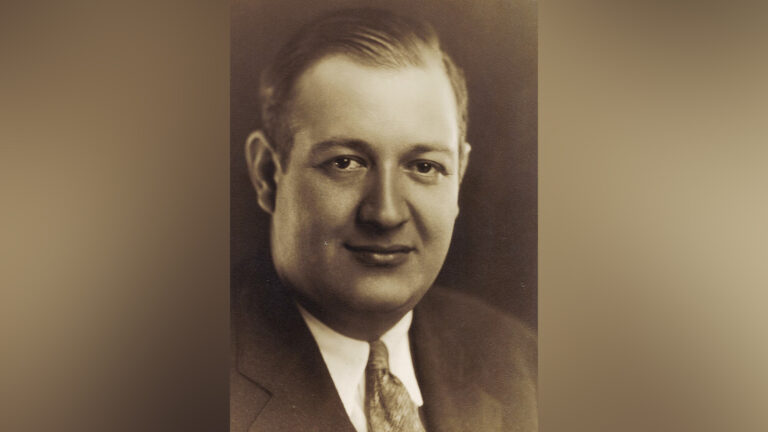
CHAMPAIGN — The world’s first Hillel was established in 1923 at the University of Illinois Urbana-Champaign by Rabbi Benjamin Frankel. Frankel’s contributions to the community are recognized with an honorary street in Champaign.
Honorary Rabbi Ben Frankel Way is located on John Street, between Fifth Street and Sixth Street. The designation came about in 2018, thanks to Erez Cohen, executive director of Illini Hillel.
“This was one of the happiest days of my life, because I really felt that we were doing right by a person that wasn’t there to do anything for his own name,” he said. “And we were able to recognize a person and something great that they have done 100 years later.”
Cohen said he enjoys being able to see the Honorary Rabbi Ben Frankel Way Street sign from his office inside the Illini Hillel building at the corner of 5th and John.
“To me, it shows that Jewish people are presented in Champaign-Urbana and recognized physically, historically for everything that they have done, and it’s a strong accomplishment,” he said.
Cohen also applied for Honorary Abram Sachar Way, which recognizes the rabbi who was a part of Hillel from 1929 to 1955 and is credited with growing Hillel into an international movement, reaching more than 800 campuses across the globe.
A century of supporting Jewish students at the U of I
Before Rabbi Frankel founded Illini Hillel, he was a full-time rabbi at the local synagogue, Sinai Temple, Cohen said.
At the time, there was already an established Jewish community in downtown Champaign and Urbana, he said. But there were roughly 200 students on campus lacking spiritual guidance, and a local Methodist minister wrote to Frankel to invite him to meet with the Jewish students.
“The students expressed that they would like to have social opportunities, educational opportunities, cultural opportunities and religious services,” Cohen said. “And Rabbi Frankel said, ‘Let’s start an organization.’ And that’s how Hillel started.”
Cohen said Hillel has now been offering these opportunities for Jewish students for 103 years.
When Rabbi Frankel founded Hillel in 1923, Cohen said the university was still in the process of building infrastructure for student life. For example, the Memorial Stadium was constructed in 1923, and the Alma Mater statue was presented to the U of I in 1929.
But Cohen said there were barriers to participating in campus life for Jewish students.
“Student organizations back then had bylaws. Part of the membership conditions said you have to be a church-goer on Sunday in order to be a member in this organization,” he said, “Jews aren’t church goers, and when they do go to observe their religion, they go on Saturday rather than Sunday.”
Cohen said the Hillel continues to support Jewish students from all backgrounds:
“If you never experienced synagogue life, but you’re Jewish, you can come to Hillel. If you went to Jewish Day School and went to Jewish summer camp and went to a synagogue throughout your life and anything in between.”
Hillel International’s global movement
Within a few years, Hillel’s influence expanded to other campuses. The University of Wisconsin established the second Hillel, and the University of Michigan and The Ohio State University soon followed.
Rabbi Frankel “wasn’t focused on creating a global movement that reaches 180,000 students annually. He was focused on serving the students at his campus right in his moment in time,” said Rabbi Ben Berger, senior vice president of Jewish Education, Community and Culture at Hillel International.
Berger said Hillel International’s goal is to work with Hillels on all college campuses to support Jewish students, providing training, funding and educational resources.
“Each Hillel is its own organization, but they are part of something much bigger,” he said. “Just as the Jewish people are part of students, each one of those Jewish students is part of something much bigger.”
Berger said Hillel has spread internationally to Australia, Asia, Europe, South Africa and now includes 16 countries. He said the honorary street designation in Champaign recognizes Rabbi Frankel’s “massive” influence on a global movement.
“It’s a reminder that one person with one little idea can make amazing, huge things happen. That’s what I think about him all the time when I want to be inspired about what I can do in this world,” Berger said.
Rabbi Ben Frankel died when he was 30, never having married or had children. Cohen said this makes Frankel’s legacy more striking.
“Every student that goes through the doors of Hillel and interacts with the Jewish community here becomes a child of Rabbi Frankel, just by the fact that he was able to, still to this day, 100 years later, affect the lives of Jewish students,” Cohen said.