

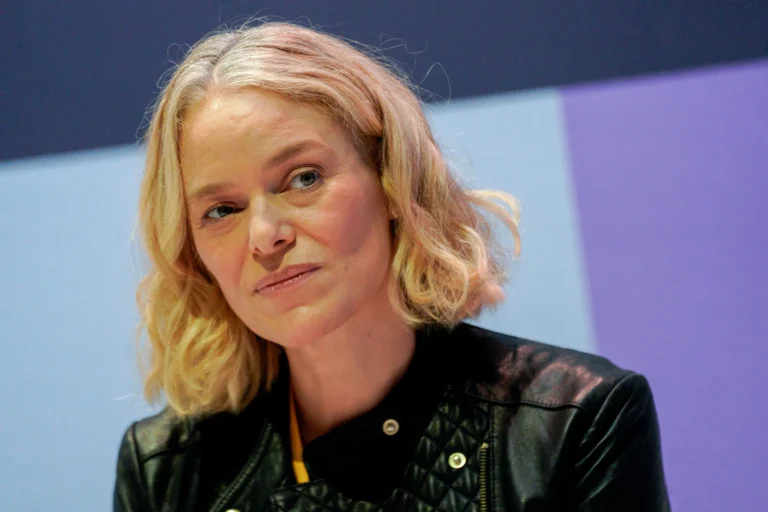
NPR is restructuring its newsroom, including cutting some reporting and editing jobs, as it attempts to keep pace with changing audience habits while adjusting to an era without federal subsidies.
NPR President and CEO Katherine Maher says the network has to fill a gap of $8 million in its $300-million annual budget because of the elimination of federal subsidies for its member stations, which pay NPR to air programs such as Morning Edition and All Things Considered. In a memo to staff, she said the network expects to earn $15 million less in station fees this year and is anticipating a drop in corporate sponsorship revenue.
“The extraordinary generosity of donors across the nation has really mitigated some of the hardest impacts of the loss of federal funding,” Maher says. “I am relieved that that is the case. And now it is our responsibility to ensure that we take that gift that they have given us and use this time to get to a place where we are sustainable for the future.”
A changing media environment
The network plans to overhaul its app and reshape its user experience across platforms to enrich the experience for listeners, readers and even viewers of its digital and streamlining products. And NPR’s senior corporate leaders — some of whom have deep roots in the world of tech — are pivoting from the mantra of “reaching people wherever they are” to encouraging people to use NPR on its own platforms.
Such job reductions represent a familiar tactic for media outlets in financially challenging times. Earlier this year, for example, the Washington Post laid off hundreds of journalists. CBS shed more than 60 newsroom staffers. The Atlanta Journal-Constitution eliminated the jobs of 15% of its staff. The Associated Press recently laid off or bought out roughly 60 journalists.
Other changes are in motion. NPR now has one of the more lenient remote-work policies among national newsrooms. The company is negotiating with SAG-AFTRA in an effort to require journalists to work in the office at least three times a week starting in the fall — a requirement that could encourage some to take the buyout. The union is seeking to ease the sting and breadth of those requirements, O’Donnell says.
Leadership shuffles and news desks merge
Evans, a CNN veteran who was named editor in chief last September, says the job cuts are deeper than he, personally, would favor.
Even so, Evans says, the restructuring is warranted.
“My hope and my drive for this is that the journalists in the newsroom at the end of this will be able to still cover the stories that make us uniquely NPR,” Evans says. “More quality over quantity. Less content for the sake of content. I want to focus our newsroom on ‘capital-J journalism’. That’s the foundation of NPR.”
He says NPR’s National and General Assignments desks next month will merge with a focus on deep dives, natural disasters, and news deserts. NPR’s regional bureau chiefs will become part of a new desk that works closely with member station journalists.
Beyond that, Evans says he is merging NPR’s desks covering culture, education, religion, addiction and sports to make a society-and-culture desk. He is unifying science and climate coverage in a single desk. And he plans to fold the global health team into the International desk.
“It’s just breaking down silos,” Evans says.
NPR’s Washington desk will expand to include the states team and NPR reporters who focus on power and money. The new desk on power and policy would take in developments on the local, state, regional and national level.
“I think it’s a healthier way for all news organizations to look at this country and the state we’re in,” Evans says, alluding to the political climate.
He also said NPR’s Business desk could add positions, as the network wants to create a new daily business podcast to complement Planet Money and The Indicator.
Evans says he has pitched NPR’s corporate leadership on reinvesting some money back into the newsroom. Maher says she is hopeful NPR can afford to do so after improvements to the network’s digital infrastructure.
They also announced shifts in the news leadership team. Prominent among them: Executive Editor Eva Rodriguez is shifting to become a consultant to the newsroom. She will be replaced by Chief Washington Editor Krishnadev Calamur. His deputy, Dana Farrington, will lead the new politics and policy desk.
The network has already reworked how it charges member stations for programming in light of the loss of Congressionally appropriated funds for public media, which had provided, on average, about 10% of public radio stations’ revenue.
Disclosure: This story was written and reported by NPR Correspondent David Folkenflik and edited by NPR Deputy Business Editor Emily Kopp and Managing Editor Vickie Walton-James. Under NPR’s protocol for reporting on itself, no corporate official or news executive reviewed this story before it was posted publicly.