

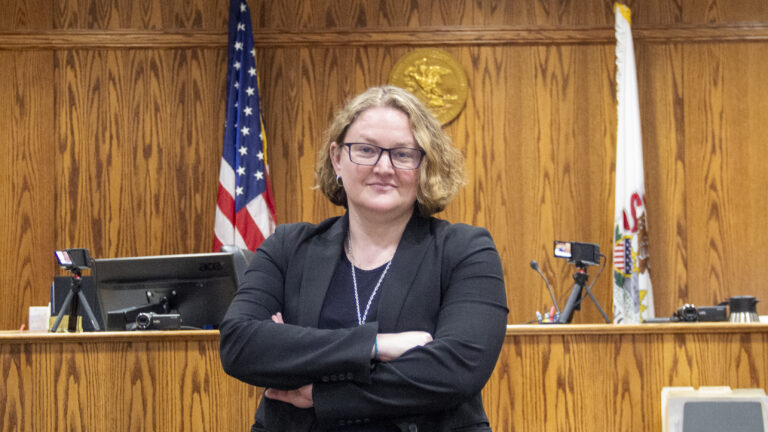
This story is part of a partnership between the Champaign-Urbana Civic Police Data Project of Invisible Institute, a Chicago-based nonprofit public accountability journalism organization, and IPM News, which provides news about Illinois & in-depth reporting on Agriculture, Education, the Environment, Health, and Politics, powered by Illinois Public Media.
CHAMPAIGN — In Illinois, over 100 people with mental illness are stuck in county jails waiting to be transferred to a psychiatric bed.
These defendants have been charged with crimes but have been found unfit to stand trial, meaning their mental health conditions are too unstable for them to understand court proceedings. A judge has ordered psychiatric treatment and the defendant now waits to be transferred to a psychiatric facility.
Under state law, the Illinois Department of Human Services (IDHS) is responsible for facilitating the transfer of these defendants to treatment within 60 days of a court placement order to one of seven state psychiatric facilities that it operates, or two private facilities it contracts with.
But the agency has long failed to complete transfers within the required time frame.
When treatment is not promptly available, the consequences can be dire. Stuck waiting in jails, many defendants receive limited support and can experience further deterioration, according to Champaign County Public Defender Elisabeth Pollock.
“Jail is not meant to rehabilitate, it’s not meant to help people get through the challenge of a mental health crisis,” she said. “And sometimes they are just locked alone for all these months.”
In 2022, a 24-year-old defendant died in Lake County Jail after waiting 67 days for a DHS psychiatric bed, according to a 2025 investigation by the Illinois Answers Project. Another defendant in the story, in Champaign County, struggled while he waited more than 200 days for a psychiatric bed.
In an effort to address the underlying issues — and help defendants access mental health treatment in a more timely and humane manner — a group of 15 people appointed by lawmakers are working to propose solutions by November.
Civil Rights attorney Amanda Antholt says it’s an urgent matter. “Leaving somebody who is unstable with symptoms of mental illness, leaving them in that instability with psychiatric symptoms active and acute is extraordinarily dangerous,” said Antholt, managing attorney at Equip for Equality, a nonprofit that serves as a federally-mandated monitor of state services for people with disabilities.
Champaign County Sheriff’s Office Captain Karee Voges agrees. Many of these defendants cannot manage basic self-care, such as cleaning and eating, and may become aggressive or attempt self-harm, she said.
“The biggest issue is keeping them from harming themselves,” said Voges, who is the administrator of Champaign County Jail.
She notes that the county jail works with mental health professionals and provides medication, but the jail is not a therapeutic facility that can provide even basic treatment to defendants declared unfit for trial.
A seat at the table to identify solutions
In 2022, the Sangamon County Sheriff’s Office filed a lawsuit against IDHS, claiming that the agency’s delays, which cite pandemic-era executive orders by Gov. JB Pritzker, were unlawful. Five other county sheriffs later signed onto that lawsuit.
Later that year, a Sangamon County judge agreed with the sheriffs and ordered IDHS to “place unfit defendants in a DHS treatment facility within 20 days of a court order for treatment,” in accordance with the law at the time.
IDHS has pushed back on criticism. At the time, the agency said it would appeal the court order, but no record of an appeal was found. IDHS did not respond to an interview request and declined to comment on the lawsuit for this story.
But in a 2022 statement released following the judge’s order, the agency said it has faced “significant challenges,” including a shortage of psychiatric beds, struggles to retain critical staff, and has “limited resources in the community to provide alternatives to justice involvement.”
The agency also later successfully pushed for the transfer timeline to be extended, according to Antholt.
The lawsuit put pressure on IDHS to make changes, which prompted lawmakers to call for the creation of a bipartisan task force in August 2025, said Mark Heyrman, a retired clinical law professor at the University of Chicago and longtime mental health advocate.
IDHS “knows that they have to fix this. The department knows that they can’t fix it by themselves,” said Heyrman, one of the 15 people appointed to propose policy solutions for this issue. They have until November to make their recommendations.
The Fitness to Stand Trial Task Force consists of representatives from numerous entities, including IDHS, mental health care, sheriff’s offices, courts, public defenders, state’s attorneys, and both Republican and Democratic state lawmakers.
In the past, it’s been difficult for lawmakers to effectively address the issue since it lies at the intersection of so many systems and government agencies, according to State Rep. Lindsey LaPointe (D-19), the co-chair of the task force.
“There were lots of ideas being thrown around [recently] in the chaos of the legislative session, trying to fix one thing or the other,” without considering the complexities of the entire fitness to stand trial system, LaPointe said.
“If we don’t take a pause and create more space to bring in the right stakeholders on this issue,” LaPointe said, “we’re going to end up moving forward on policy that’s not really going to solve the problem.”
Waiting months for transfer
After the 2022 lawsuit against IDHS, lawmakers passed a state law the next year that extended the timeline for transferring defendants found unfit to stand trial to state psychiatric facilities from 20 days to 60 days.
Despite warnings from the Illinois Sheriffs’ Association that the extension could make delays worse, state officials argued the measure would establish a formal 60-day deadline for transfers after a finding of unfitness, which would allow IDHS to free up beds for treatment.
But the statute does not specify penalties if the deadline is missed. Instead, it allows the Illinois Department of Human Services to exceed the 60-day timeline if it can “demonstrate good faith efforts at placement and a lack of bed and placement availability.”
Three years in, data obtained from IDHS through public records requests show that the extended timeline did not, in fact, reduce defendants’ waiting times, according to an analysis by IPM News and Invisible Institute. Median wait times across the state continued to increase from 2023 to 2024 and as of late 2025, hovered around 90 days.
Data provided by IDHS includes all people waiting for a court-ordered transfer to a state psychiatric facility, whether in jail or in the community. IDHS said the agency does not track a person’s waiting location.
But others, like public defender Elisabeth Pollock, point out that legal action cannot fix the problem because they fail to address the underlying issues that lead to transfer delays.
“This is not a matter of DHS just not wanting to do their job. It’s a matter of them not having the space,” Pollock said.
By law, defendants deemed unfit for trial are placed in the custody of IDHS, making the agency responsible for facilitating their treatment.
“You cannot force people into space that doesn’t exist,” she said “We cannot force people out after 60 days or 20 days or whatever it is. To me, it’s something that I don’t even pay attention to because I can’t do anything about it.”
Roughly 15% of defendants in Illinois were transferred in 60 days or less in the two years after the law extending the transfer timeline took effect in January 2023.
During that same timeframe, in Champaign County, just 11% of defendants waiting for a psychiatric bed were transferred within the first 60 days.
In Champaign County, the median wait time for transfer to defendants deemed unfit for trial has exceeded the statewide median every year from 2019 through 2025, according to IDHS transportation records.
The average median wait time over that seven-year span in Champaign County was 99 days.
There are 11 defendants currently waiting in Champaign County Jail for court-ordered psychiatric treatment, according to an email update from Captain Voges.
In her nearly 12 years of experience at the Champaign County Jail, Capt. Karee Voges said IDHS has never met the court-ordered transfer timeline.
“It’s a sitting game and we wait until DHS has a location for them for us to transfer them to,” she said.
In search of both upstream and downstream solutions
The 2022 lawsuit brought by Sangamon County Sheriff’s Office against the state helped pressure IDHS to make changes, according to Mark Heyrman.
In a statement, an IDHS spokesperson said since 2021, the agency has added more than 200 forensic beds, and has been participating in additional projects and pilot programs aimed at adding even more capacity in the coming year.
The agency has an additional 32 beds available “as part of a jail-based mental health pilot program in Kankakee and McHenry County Jails, providing jail-based mental health services prior to inpatient admission,” the statement said.
The pilot program aims to relieve pressure on smaller county jails and provide defendants with more access to treatment and medication – but it still redirects people to jail.
“It’s not like a hospital or anything like that,” said Voges. “They just have enough cells and they have enough officers that they were able to take on this project for them.”
IDHS also contracts with private inpatient mental health providers in the Chicagoland area, including UChicago Medicine Ingalls Memorial Hospital and Lake Behavioral Hospital; admission to those facilities counted for 18% of all transfers in 2025.
IDHS also said it provides funding for community-based outpatient restoration services, according to the statement. The department did not specify the amount of the funding it provides, or how many defendants this applies to.
Heyrman, the chair of the Fitness to Stand Task Force’s legislative subcommittee, said the group is trying to work quickly to propose solutions.
The goal is not to fix the entire mental health system but rather consider input from stakeholders to determine immediate and practical changes.
“You can’t just say to the governor now when we have a budget crisis, ‘Oh, you have to spend a lot more money on community mental health services,’” Heyrman said. “The thing that needs to happen is to say, ‘Okay, here’s a very specific solution that is focused on the people who are the most expensive.’”
The costs are highest for managing people who repeatedly cycle into the fitness-to-stand-trial system, Heyrman said.
Those “repeat players” place a financial burden on local police departments, IDHS, county jails, sheriff’s’ offices and the courts, and should therefore be the focus of any solutions put forth.
“Not that we don’t care about the rest of the folks, but there are people who keep coming back,” Heyrman said.
LaPointe said while the task force primarily focuses on the fitness-to-stand-trial system, she wants to consider the broader picture of mental health, and envision both upstream and downstream solutions.
Increasing access to community mental health services can prevent recidivism by helping people “manage their symptoms and lead a full and regular life,” LaPointe said, which in turn, reduces crime and improves public safety.
Another example is building more robust homeless services, “that actually provide emergency shelter for people struggling with mental illness,” she said.
The ultimate goal of the task force, Heyrman said, is to reduce the number of people entering the criminal justice system — rather than just foster the pace of admitting people into psychiatric facilities.
“There’s no reason to keep you in the hospital if we can treat you safely in the community,” he said.
A glimpse at Colorado’s approach: What can Illinois learn?
At a February virtual task force meeting, guest speaker Jennifer Turner, executive director of Bridges of Colorado, described how Colorado is working to address similar issues in its criminal justice system.
The program grew out of a Colorado Senate bill passed in 2018 that recognized the disproportionate involvement of people with mental health conditions in the criminal legal system. It created a statewide liaison’s office to help coordinate agencies across the fitness system.
The liaison serves as a case manager for each defendant, traveling across the state to coordinate with the attorneys, courts, sheriff’s offices and outpatient and inpatient treatment providers involved in the fitness-to-stand-trial process.
Turner said liaisons work to connect defendants to community-based mental health care, which leads to lower recidivism rates — and fewer repeat players. This saves money for both the courts and the county jails, since outpatient care is significantly less costly per day than a jail stay or inpatient psychiatric stay.
The funding for the Bridges program is based on an estimation of how much money the courts will save through operating this program.
According to Bridges of Colorado’s website, the program developed into an independent state office with over 100 staff members in 2023.
During her presentation, Turner said the program served about 4,600 participants in fiscal year 2025, which helped the state avoid more than $110 million in psychiatric bed costs and $6 million in jail expenses.
“That is very different from anything I’ve seen in Illinois,” LaPointe said in an interview.
What stands out from Colorado’s model, she said, is that the state has liaisons solely dedicated to connecting different stakeholders and supporting defendants as they navigate the fragmented system — all with a relatively manageable annual budget of around $10 million.
“And in the grand scheme of things, if we were to just take that $10 million and try to spend it in Illinois, that’s not a lot of money for the number of people that cycle through the system today with poor outcomes,” LaPointe said.
Lasting change will take time — and a significant investment from the state
Addressing the problems faced by the fitness-to-stand-trial system will require significant investment in community mental health care — both to prevent people from entering the criminal justice system to begin with and to help those who are already in it, LaPointe said.
While the majority of defendants found unfit to stand trial will receive inpatient treatment in state psychiatric facilities, new policies in recent years have prioritized outpatient referrals for some defendants charged with misdemeanors, according to reporting from the Illinois Answers Project.
But one task force member said the cooperation between community health centers and the courts is chaotic.
Christina Overton is the director of services for Stepping Stones, a community health center in Rockford. The center provides outpatient health care to more than 400 clients each year and receives about 20 referrals annually for fitness-to-stand-trial outpatient treatment.
Once a person is referred by the courts to community health services, the courts expect defendants to get plugged into treatment. But Overton said clients can be hard to track down to schedule visits, especially if they’re homeless or in a difficult living situation.
Overton said her mental health center receives an annual state grant of up to $70,000 to help track clients referred by the courts who are reluctant to engage in psychiatric treatment.
The funding is meant to account for the additional time community providers spend trying to get defendants in the door. The grant does not cover medication or treatment costs for any clients.
“So if the client has Medicaid, then the services we provide, we will bill to Medicaid,” Overton said. But funding from the state grant cannot be used to cover treatment costs for clients who are ineligible for Medicaid or otherwise uninsured.
For these clients, Overton said she has to “either do the work for free” or charge clients out of pocket on a sliding scale.
Her experience has been frustrating, but Overton said she continues to accept referrals from the state because she cares about these clients.
At the same time, she said, the state “can’t expect us to do the work just out of our kindheartedness… I can’t go out of business because that doesn’t help anybody.”
In February, when Overton attended the virtual task force meeting featuring the Bridges of Colorado speaker, she said her mind was blown when she learned the program is funded through the court system.
Overton said she’s not optimistic that Illinois’ court system would ever approve funding to build a liaison’s office like the one in Colorado.
“Hell will freeze over in Illinois before any court gives up any of their dollars because I can’t squeeze a dime from our court system to help get any funding,” she said.
But she’s glad she has a seat at the table to provide her perspective as a community mental health provider.
In the coming months, the task force will continue to review current laws and policies to identify gaps and will present a report in November to lawmakers with recommendations for legislative changes, Heyrman said.
“We’ve got some good people on the task force,” he said. “We will probably recommend some changes… that will help make the trains run a little more smoothly and efficiently, move things along more quickly.”
Ultimately, the task force does not have any enforcement power. Heyrman said it will be up to state lawmakers and the governor to implement the proposed changes.
In the meantime, defendants stuck in county jails across the state await news that a bed is open for them.