

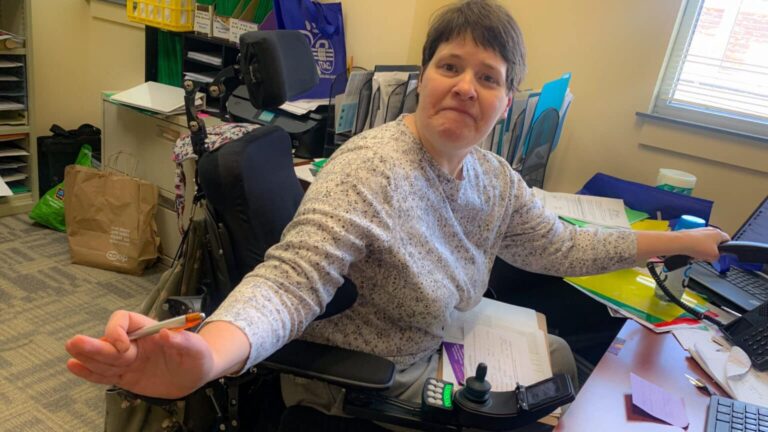
For Paula Vanier, a computer is essential for much of her written communication.
Because of her cerebral palsy, typing is often easier than writing by hand. But like many people with disabilities, the tools she depends on are not cheap, and saving for them can be tricky.
In Illinois, asset limits tied to public benefits can make even modest savings risky. Single people who receive Supplemental Security Income (SSI) and some disability-related Medicaid programs must have a savings of about $2,000 or under to remain eligible for benefits. Vanier, a coordinator for personal assistants and support workers at the Persons Assuming Control of their Environment (PACE) Center for Independent Living in Urbana, also relies on Medicaid and said those limits can shape major financial decisions.
“You’re always scared,” she said. “You should be able to use something that lets you save more than the limit.”
A push to expand awareness of ABLE accounts
State Sen. Paul Faraci (D-Champaign) is sponsoring Senate Bill 3008, which would require the state to provide information about financial independence resources for people receiving disability services.

The bill focuses on the Senator Scott Bennett ABLE Program. Named after the late state senator from Champaign who championed the original legislation, ABLE accounts allow people with disabilities to save and invest up to $100,000 for qualified expenses — such as transportation, education and assistive technology — without losing eligibility for state benefits.
Despite the program’s potential to provide a safety net, Faraci says the biggest hurdle remains awareness.
“The Senator Scott Bennett ABLE Program is a critical resource that can provide tangible relief for individuals with disabilities who are looking to save for their futures,” he told IPM News in a statement. “However, like any resource, it is only helpful if residents know it exists.”
The High Cost of Independence
Saving is about more than just money for Vanier— it is critical for covering her everyday needs.
Vanier uses her own ABLE account to keep her standard bank balance below the state’s asset limit while preparing for large, unexpected expenses. She said the accounts can work in tandem with other tools like a Special Needs Trust.
“I just put money in there to keep my account down,” Vanier said. ” I got my mini van, and when I needed to pay for a repair, I took some money out of that money out of the accounts.”
Research from the National Disability Institute suggests the cost of living can be nearly 30% higher for a person with a disability than for a non-disabled peer.
Without this shielded savings, an emergency repair could have forced Vanier to choose between choosing her transportation or keeping the Medicaid benefits she relies on for her daily care.
“A car that costs $20,000 might be fine, but because of my disability, I need an accessible vehicle, which can cost three times more,” Vanier said.
Legislative Path Forward
Faraci said his bill aims to follow in the “footsteps” of Bennett’s advocacy by ensuring financial empowerment starts at the moment of enrollment rather than forcing residents to find resources on their own.
“By ensuring individuals with disabilities and their families are aware of programs like the Senator Scott Bennett ABLE Program, we can safeguard their ability to build financial independence without violating the eligibility rules,” he wrote.
Senate Bill 3008 has cleared two readings and is currently on the order of its third and final reading in the Illinois Senate. If passed, it will move to the House for further consideration.