

The bald eagle used to be a rare sight in Illinois. Now, there are more than 3,000 that spend the winter here.
Iwanicki said the recovery demonstrates the potential for humans to take action and make a difference.
“It was also a success story,” she said. “It was humans realizing there was a problem, understanding what that problem was, and knowing there was a solution, and coming together and agreeing to make the solution happen.”
It was a good day for birders at McHenry Dam. Iwanicki pointed out ducks splashing in the open water.
“I am looking at common golden eyes and redheads,” she noted. “There’s two redheads. They’re kind of self-explanatory — their heads are very red.”
Eagles also often stir up Canada geese.
“Seldom do they ever catch one of the geese, but it gets their attention, and the whole raft of geese will just float up all at once. It has not happened yet today, but it’s impressive when it does.”
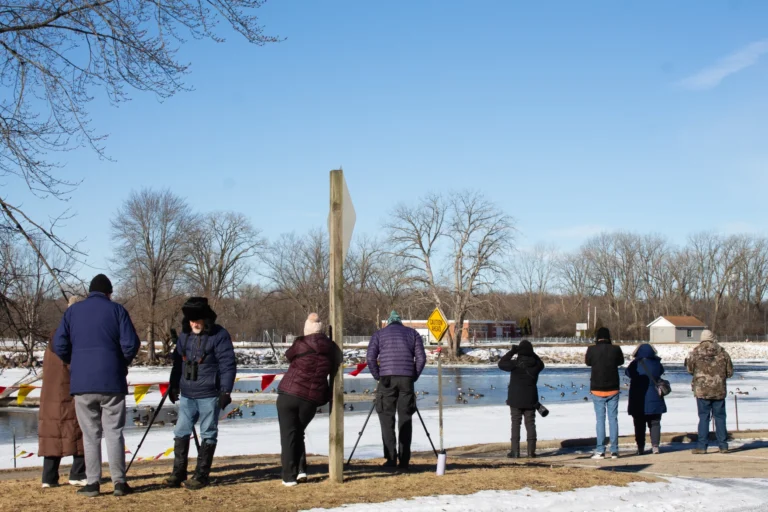
It was a cold, quiet Saturday in February, when a couple dozen people gathered by the open water behind McHenry Dam on the Fox River.
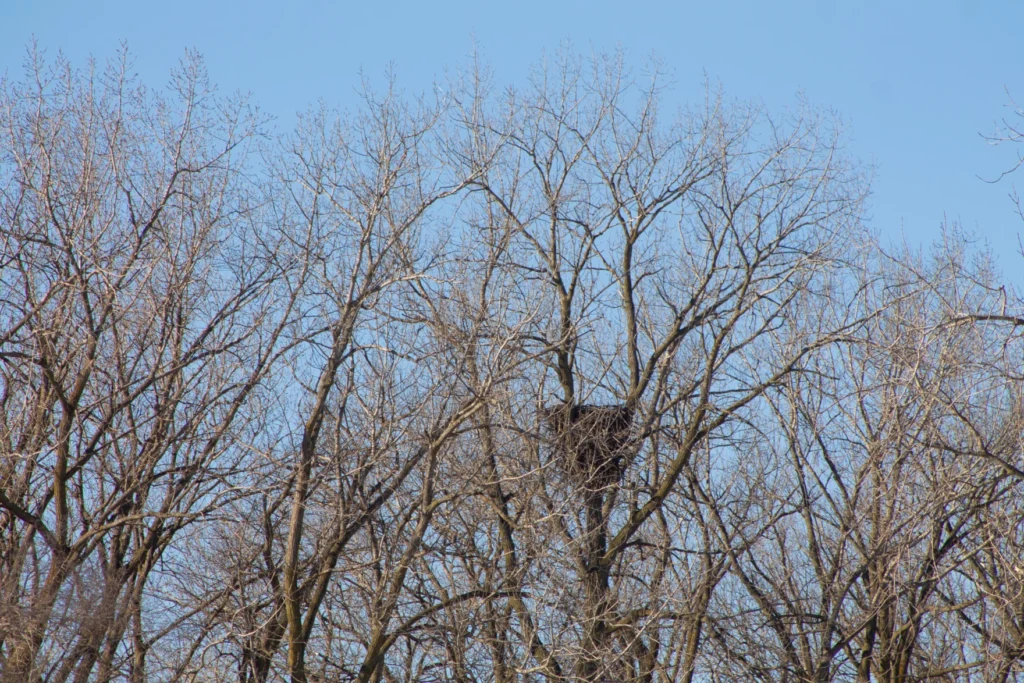
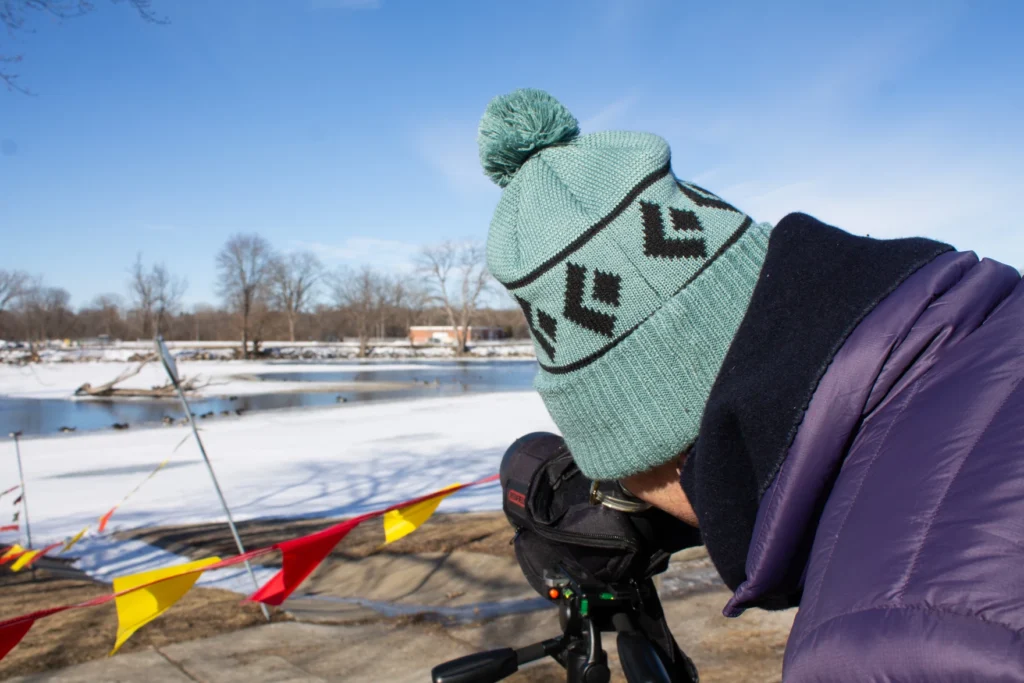
They huddled together in the parking lot, bundled up against the cold. A few crouched behind spotting scopes, long-range telescopes set up on tripods, trained on a large nest up in a tree on the other side of the river.
They were looking out for bald eagles.
This gathering was part of an eagle-watching series hosted by the Illinois Department of Natural Resources, McHenry County Audubon and other conservation groups. Eagles are easier to see in the winter, before the trees leaf out.
Bald eagles used to be rare in Illinois. Now, there are more than 3,000 spend the winter in the state. According to the IDNR, Illinois is home to the largest wintering population of eagles in the continental U.S., a noted conservation success story.
At one point in the morning, the pair of eagles returned to their nest, perching together on a tree across the dam, appearing as two brown dots on a branch.
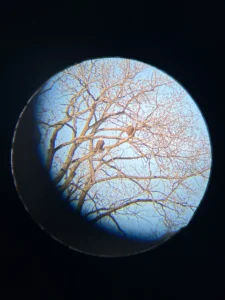
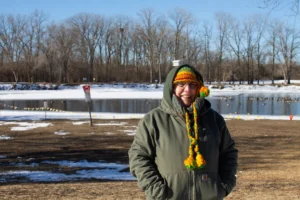
The scopes set up by IDNR and McHenry Audubon are much more powerful than binoculars alone. Bird enthusiast Susanne Petersson said they allowed her to see the eagles in much greater detail.
“We get to see eagles up close and personal, because we don’t have this type of equipment,” Petersson said. “We would see a spot in the sky. So this is really terrific.”
Eagle-watching events have been held across the state in January and February. But, because the nest is so visible from this vantage point, IDNR’s natural resource coordinator Stacy Iwanicki said visitors can see them pretty easily here.
“They’ll come to where they can find the open water, which when the river freezes, generally, is just on this on the downstream side of dams,” Iwanicki said. “Which is what makes McHenry Dam such a great location.”
Seeing these birds would have been nearly impossible a few decades ago.
Bald eagle populations were almost nonexistent in Illinois in the 1970s, mainly because of widespread DDT use, a pesticide that built up in the fish eagles ate. DDT disrupted their endocrine system, thinned their eggshells and ultimately decimated the reproduction of eagles. DDT was banned in 1972. Soon after, IDNR and the Audubon Society started protecting habitat for the birds. In the late 1970s, there was just one nest found in Illinois. Now, bald eagle nests are found in most counties.
Iwanicki said the recovery demonstrates the potential for humans to take action and make a difference.
“It was also a success story,” she said. “It was humans realizing there was a problem, understanding what that problem was, and knowing there was a solution, and coming together and agreeing to make the solution happen.”
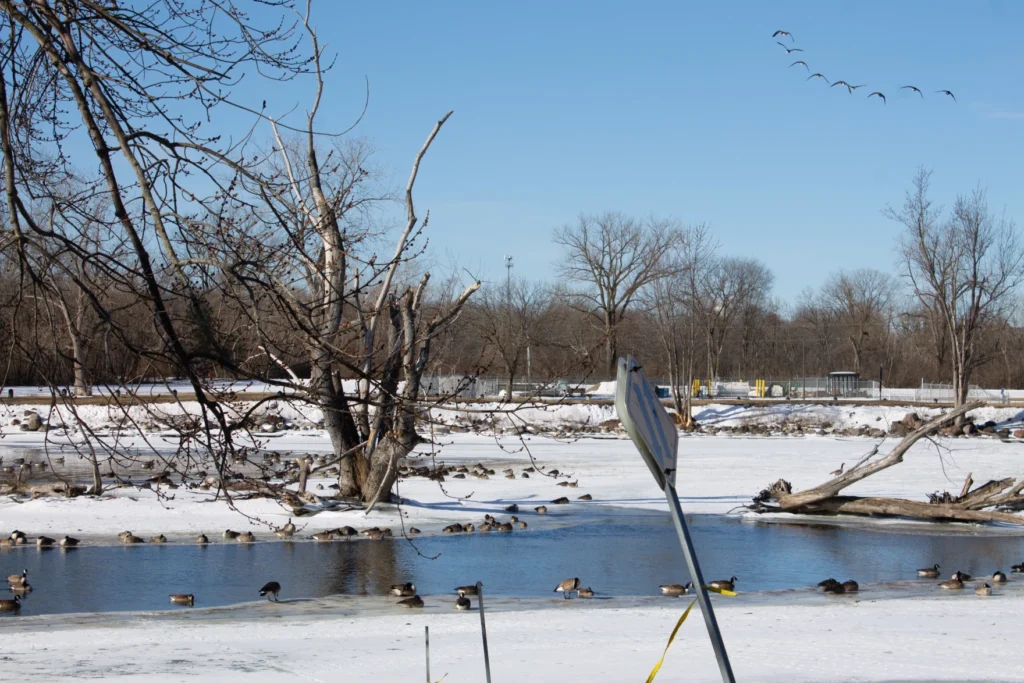
It was a good day for birders at McHenry Dam. Iwanicki pointed out ducks splashing in the open water.
“I am looking at common golden eyes and redheads,” she noted. “There’s two redheads. They’re kind of self-explanatory — their heads are very red.”
Eagles also often stir up Canada geese.
“Seldom do they ever catch one of the geese, but it gets their attention, and the whole raft of geese will just float up all at once. It has not happened yet today, but it’s impressive when it does.”
Events like this are special because they get people outside and away from screens, said Jim Bolm, a board of member at the Friends of Moraine Hills State Park.
“It’s meaningful to the people to be able to come to a place where you have some quiet,” Bolm said. “You can see other animals — whether it’s the birds or beavers, turtles, snakes, all these things — and to be able to see that instead of being constantly in an artificial world.”
Susanne Petersson has attended the eagle-watching event for several years and was excited to see a nesting pair.
“It’s just the grandiosity of nature,” she said. “They’re just so beautiful. And I mean, I get excited over the geese too.”
The event is simple — visitors show up, observe and maybe meet other bald eagle enthusiast. But there’s something deeper, Iwanicki said.
“Nature’s a great equalizer,” she said. “We can all come together, regardless of what the rest of our life looks like, and just enjoy nature. Bald eagles are a gateway to understanding nature in a broader scale.”
Nesting season is underway. Pairs take turns incubating eggs, which usually hatch in March and April. Eaglets may be visible at the dam in the coming months.