

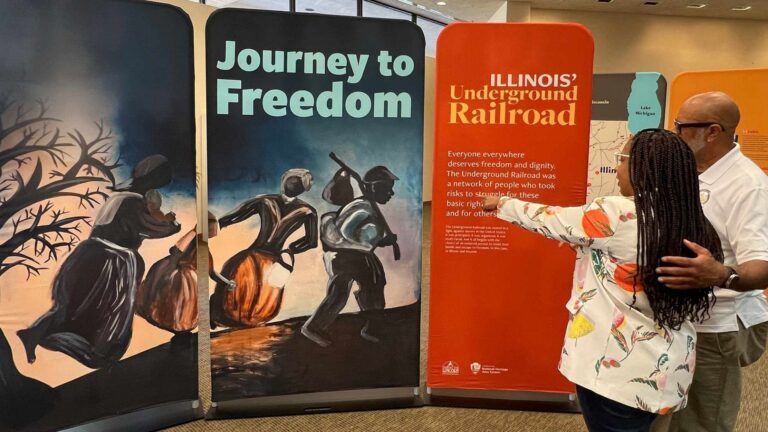
URBANA — The Urbana Free Library is hosting a new traveling exhibit highlighting people around Illinois who were involved with the Underground Railroad. Journey to Freedom: Illinois’ Underground Railroad runs through March 29 and is presented by the Abraham Lincoln National Heritage Area. The library and the Champaign County African American Heritage Trail collaborated to also show how east central Illinois was involved with the Underground Railroad.
Morning Edition host Kimberly Schofield spoke with Pat Cain, the library’s Archives Manager, and Dr. Barbara Suggs-Mason, co-chair of the Champaign County African American Heritage Trail, to learn more about the exhibit and the area’s hidden history.
This interview has been edited for clarity and conciseness.
BARBARA SUGGS-MASON: I think one of the difficult pieces in looking at East Central Illinois and its direct involvement with the Underground Railroad is the fact that so many of the stories have not been written down. It’s been an oral tradition, stories passed on. There is some evidence, but I think that what we find is that in some cases, there’s no conclusive proof. But we know that many of the individuals we’ve identified were abolitionists and there’s evidence in other places that they lived, that they were involved in the Underground Railroad.
A great example of somebody who consistently we seem to have information about would be Abraham Smith, who was a Quaker, who lived in Vermillion County and who was very active in the Underground Railroad from the time he moved there until his death in 1863. So there’s evidence. Unfortunately, the Freedom Seekers — men and women who were African American — didn’t necessarily write their stories down, and many of the White individuals who were involved because they were quote unquote, ‘breaking the law,’ they didn’t always write their stories down either. So we listen to stories that have been passed down through oral tradition or evidence that we can find, occasionally, from sites and papers that were left by those individuals.
KIMBERLY SCHOFIELD: Pat, what does it mean for the library to share something like this to the community?
PAT CAIN: The library, you know, we’re here to serve all within Urbana and then particularly with Champaign County Historical Archives, serve all within the county, and that includes, you know, telling all stories from our county’s past. Hopefully, with an exhibit that, you know, as Barbara was mentioning, there’s not much sort of hard proof when it comes to some of these stories, but hopefully, when we can bring these stories to light and have them told within the community, it draws more attention to these stories, people are talking about it more. And hey, maybe more stories will come to light. Some may talk to their family members and hear about some of these oral traditions and these oral stories that Barbara was mentioning. And people may reach out or may look to document them themselves. And it really just gets the conversation going around our community’s history, which is what we’re here for.
SCHOFIELD: Barbara, is there anything — or it could be a series of things — that you hope the community members gain from attending this event?
SUGGS-MASON: I think it’s important, and I’ve been committed through the Heritage Trail, the African American Heritage Trail, and I think Experience Champaign-Urbana has been committed to that, that we tell stories that have been untold, that have been hidden, particularly for the African American community. I was very lucky. I grew up in a family where not only did we have the oral tradition, but I had grandmothers who saved everything, so it helps us to tell our story. And it’s amazing the number of people who have pictures and documents in their attic that they’ve never opened, and once they do, they can begin to share their stories, of their family, their traditions. I think that is important to be represented within the community of Champaign.
For instance, through the work with the Heritage Trail and research, we found out that in 1869,
Frederick Douglass, who was a Black abolitionist and speaker, was invited to Champaign, to downtown Champaign to be a speaker for a fundraiser when they were trying to raise money for the Champaign library. So it’s amazing that in a county that was predominantly White, with few African Americans, one of the probably greatest orators — one of them, certainly of that period of time — who was African American, was invited to speak before the public here. Untold stories. Stories that we want to bring because it tells us and helps us. By looking at the past, we’re able to understand better why we are where we are now. And I think that that’s vital.
CAIN: Yeah, I think she said an important point really well: connecting the past with the present. I used to be a high school history teacher and one of the things I really enjoyed about the job was working with students to connect the past with the present. Looking at stories, themes, from the traveling exhibit, from the local companion exhibit that we’ve been working on together, I’m reminded of a lot of themes and stories that we’re seeing in present day.
You see stories of neighbors and communities working together in the face of some challenging realities, and that struggle for fairness and equality … things that we still see communities and neighbors working towards today. So the past, although it might be over 100 years ago, there’s a lot of things from the past that still ring true today. Hopefully, when we can work with the community to make those connections, we can learn from the past and live in our present at the same time.